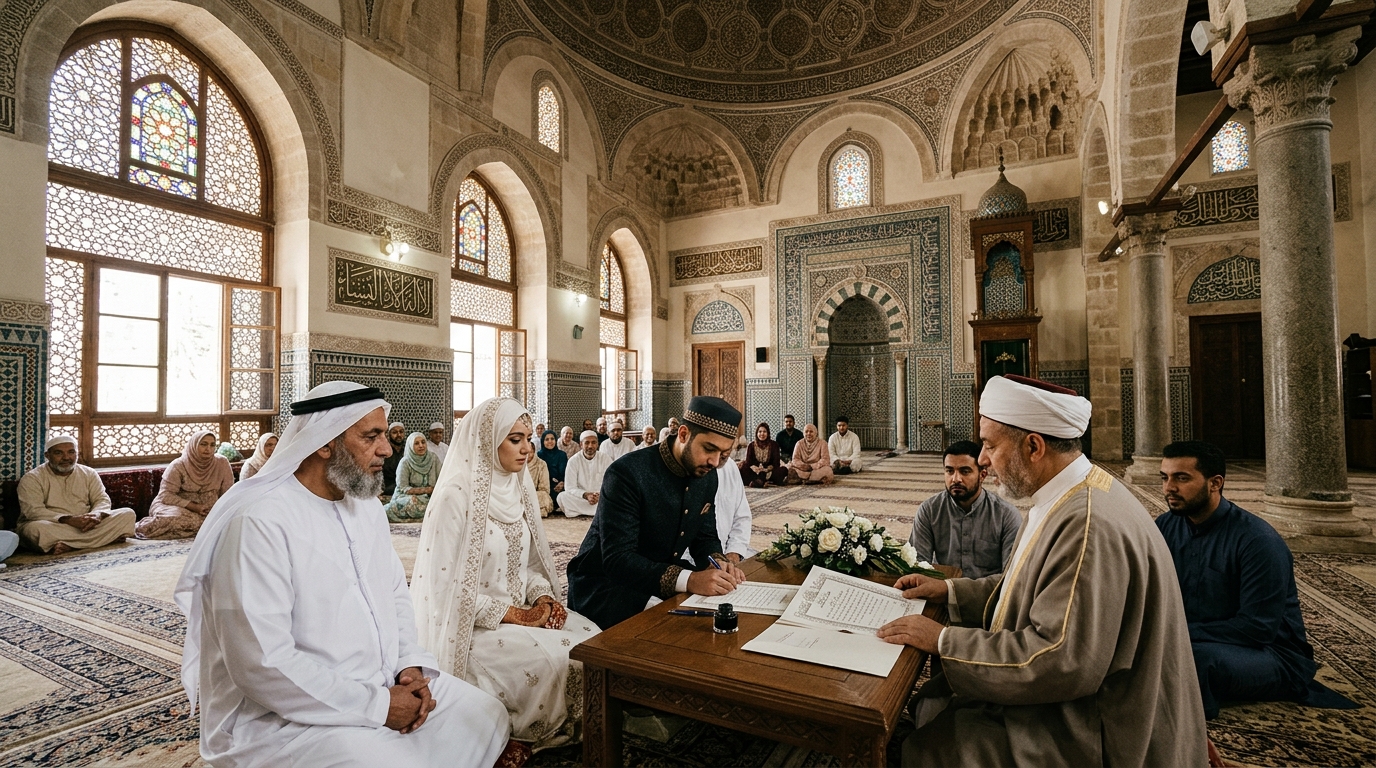
A marriage document and a pen on a desk beside a passport.
Married, and Living in Two Countries: The Years Spent Waiting for a Visa
They signed the contract in March. The application went in that summer. Two years later they were still married, still apart, and still refreshing an inbox that never had anything in it.
They signed the contract in March, in a room with both families and a plate of sweets, and it was a good day. The application went in that summer, with a folder of documents so thick that the woman at the counter had to ask for a second envelope. Everyone said these things take a few months.
By the following spring they had received one letter asking for a document they had already sent. By the autumn, nothing. Bilal was in one country and Sana was in another, married in every sense that mattered to them and to God, and living the kind of life where you check an inbox eleven times a day and there is never anything in it.
What nobody prepares couples for is not the distance. It is the shapelessness of it — the fact that you cannot plan, cannot say when, cannot answer the question every relative asks at every gathering, and cannot even be properly sad, because technically nothing bad has happened. You are simply waiting, and the waiting has no end you can see.
What the wait actually does
The first months are usually fine. There is novelty, there are long calls, there is the sense of a shared project. Both of you are busy assembling papers and there is something to do.
It changes somewhere around the first year, when the couple realise they have started living separate lives that are not converging. He has a routine she is not part of. She has friends he has never met, jokes he does not understand, a whole daily existence that happens off-screen. Each of them starts to become a person the other hears about rather than lives with, and the calls slowly turn into updates: what happened today, what the lawyer said, whether the money came through.
Then there is the particular loneliness of being married and having nobody to show for it. She goes to weddings alone. He eats alone. When she is ill there is nobody in the flat, and the person who should be there is on a screen, six hours away, useless with worry. Married people who live apart often say the hardest part is not the missing; it is doing ordinary difficult days without the one person who is supposed to be there.
And it is expensive in a way nobody counts. The flights, the lawyer, the translations, the certified copies, the trip that has to be taken because a document expired. Many couples in this situation are also sending money home, and the wait quietly eats years of savings that were supposed to start their life.
Why the relatives make it worse without meaning to
At every family gathering somebody asks when she is coming. It is asked warmly, and it lands like a stone, because the honest answer is that nobody knows and no amount of asking will change it.
Worse are the theories. An uncle knows a man who did it in three months. A cousin says they must have filled the form wrong. Someone suggests, eventually and delicately, that perhaps the marriage was not meant to be — and that suggestion, once made, sits in a mother's mind and comes back in a bad week.
The kindest thing a couple can do for themselves is agree a single sentence and give everyone the same one: it is with the authorities, we do not have a date, we will tell you when we know. Repeated calmly, it ends the interrogation without a quarrel. And the kindest thing a relative can do is stop asking and instead ask something else entirely — how she is, what she is studying, whether he has eaten — because those questions treat the couple as people rather than as a stalled application.
What actually keeps a marriage alive across a border
The couples who survive this well do a few unglamorous things, and almost none of them involve romance.
The first is that they share ordinary life rather than only news. A call where two people cook at the same time, or watch the same thing, or simply leave the line open while they work, does more for a marriage than a weekly summary of events. Intimacy in a long separation is built out of the boring hours, not the important ones.
The second is that they treat the paperwork as one shared project with one system: a single folder, a list of what has been sent and when, the renewal dates of every document written down a month early. It sounds bureaucratic and it prevents the most common disaster in these cases, which is an application collapsing because something expired while nobody was watching.
The third is that they keep visiting, even when it is expensive and inconvenient, and they space the visits deliberately rather than waiting for a good moment. A couple who know they will see each other in four months live differently from a couple with nothing in the calendar. If travel is impossible for one of them, the other goes, and if neither can, then a fixed date to review the situation serves the same purpose: it gives the waiting a shape.
And they protect the marriage from becoming only about the case. Couples who talk about nothing but the visa for two years arrive at the airport as two people who have been in a legal process together, not as a husband and wife. Talk about other things. Argue about a film. Plan something small that has nothing to do with immigration.
The honest questions
Two questions have to be asked out loud at some point, and most couples avoid both.
The first is what happens if this never works. Some applications fail. Some countries close a route entirely. A couple who have never discussed the alternative — a third country, a different plan, or an honest end — are far more damaged when the refusal comes than a couple who have said, once, calmly: if this does not work, here is what we would consider.
The second is harder and more private: is this still a marriage, or has it become two people keeping a promise? There is no shame in the question. Being married on paper while living entirely separate lives for years is a real weight, and it deserves to be looked at honestly rather than endured out of embarrassment. Most couples who ask it discover the answer is yes, this is still a marriage — and asking it out loud is what lets them stop wondering in silence.
Islam does not ask anyone to live in a permanent limbo without speaking about it. A marriage carries rights on both sides — companionship, support, being looked after — and when circumstances prevent them, the two people involved should be talking about it together, and involving someone wise if they cannot see a way. Patience is a virtue. Silence is not the same thing as patience.
Bilal and Sana
It took three years and two months. The second application succeeded for reasons nobody ever fully explained, and Sana arrived on a Tuesday in November with two suitcases and a bag of her mother's cooking.
The reunion was not the film version. They were shy with each other for a fortnight, and there was a strange week where both privately wondered whether they had become strangers. They had not; they had simply spent three years being extremely good at talking on a screen and had lost the habit of sharing a room.
What Bilal says now, when younger cousins ask, is that the wait was the hardest thing he has done and that the thing which saved it was ordinary: they had never let the marriage become only about the case. They had argued about football, and complained about the weather, and once spent an entire call deciding what colour to paint a kitchen neither of them had yet seen. That kitchen is painted now. It took three years to get to it, and the colour is exactly what they chose.
For the daily practice of staying close across a border, long-distance marriage is the companion piece, and international marriage paperwork covers the documents themselves.
Questions couples ask
How do couples survive a long visa wait?
By treating it as a shared project rather than one person's problem: a fixed rhythm of contact, one person tracking every document and deadline, and a plan that is reviewed rather than a wait that is simply endured.
What is the most common paperwork mistake?
Letting documents expire. Several must be recent when submitted, so ordering everything at once often means ordering half of it twice. Ask the consulate for the current list rather than trusting an old forum post.
How do we handle relatives who keep asking?
With one short, repeated sentence that gives them nothing to build on. Most of the pressure comes from people who mean well and simply do not understand that the couple has no control over the timeline.
Should we visit while waiting?
Where it is affordable and permitted, yes — visits are what keep the marriage a marriage rather than an administrative status. Plan and save for them deliberately rather than leaving them to chance.
When does the waiting become something else?
When contact drops, when either of you stops making plans, or when the relationship exists only as logistics. That is the point to speak honestly rather than to wait for an envelope to fix it.