Postponing a Wedding Without Ending the Marriage Plan
A postponed wedding does not always mean a broken match. What matters is whether the delay is clear, mutual, time-bound and handled with honesty rather than vagueness.
A wedding delay can feel heavier than the practical reason behind it. One phone call about money, visas, illness, housing or family pressure suddenly shakes months of trust. People begin to ask questions. Relatives fill the silence with theories. The couple themselves often do not know whether they are dealing with a temporary obstacle or the beginning of a slow collapse.
That is why postponement needs more than patience. It needs structure. A healthy delay is not just “let us wait and see.” It is a conscious decision with a clear reason, a realistic timeline, and behaviour that keeps the relationship honest while plans are being adjusted. Without that structure, postponement stops being a practical step and becomes a fog in which attachment deepens but commitment weakens.
You can postpone a wedding without ending the marriage plan if the reason is real, both families understand it, the couple agree on what remains committed, and the delay has a review point instead of endless vagueness. A delay protects the match only when it creates clarity; when it creates drift, secrecy or repeated non-decisions, it is no longer a wise postponement.
First decide whether the obstacle is practical or relational
A wedding should be postponed for a problem that needs time, not used to hide doubts no one wants to name.
Some reasons are clearly practical: a visa has not come through, a parent has had a medical emergency, one person has lost work, housing has fallen through, or a key legal document is delayed. These problems may be serious, but they are concrete. A couple can describe them, estimate what needs to happen next, and work around them together.
Other “reasons” are much less stable: one family feels uneasy but cannot explain why, one person keeps asking for more time without identifying what would change, or practical excuses keep shifting because the real issue is ambivalence. A practical obstacle may still be painful, but it usually invites planning. Hidden hesitation invites vagueness. Those are not the same thing and should not be treated as the same.
If the venue is cancelled and the couple need two extra months to organise a smaller event, that is a logistical delay. If one side says “let us postpone for now” but cannot say what decision they are actually waiting to make, the issue is no longer the venue.
Clarify what is still agreed and what is not
A postponement becomes survivable when everyone knows whether the commitment remains intact or is being reconsidered.
Many couples make the mistake of postponing the event but never defining the status of the relationship. Are you still proceeding toward marriage, with a revised date to be set after one specific issue is resolved? Or has one side effectively reopened the whole decision while trying not to say so aloud? The emotional consequences of those two situations are completely different.
Say it plainly. If the marriage plan remains in place, state that the intention is unchanged and only the timing is moving. If the decision itself is now under review, say that honestly too. False reassurance helps no one. It keeps one person emotionally invested in a certainty that the other person has already downgraded to a possibility.
Put a review point on the delay
A healthy postponement has a next decision date, not an open-ended emotional waiting room.
- Name the reason for the delay in one sentence everyone can repeat consistently.
- List the conditions that need to be met before a new date is fixed: savings target, medical recovery, housing, paperwork, family meeting, or travel approval.
- Set a review date, even if you cannot set the wedding date yet.
- Agree who will update whom, and how often, so the waiting period does not become silence.
- Decide what happens if the obstacle is not resolved by the review date: extend once, simplify the event, proceed with nikah only, or reconsider the match honestly.
Simplify the wedding before you sacrifice the marriage
Many delays are caused less by marriage readiness than by event inflation.
A striking number of postponements happen because the wedding grew into something financially or socially exhausting. The guest list expanded. Multiple events became expected. Families attached dignity to spectacle. At that point the couple are no longer delaying marriage for a genuine barrier; they are delaying it to satisfy a performance.
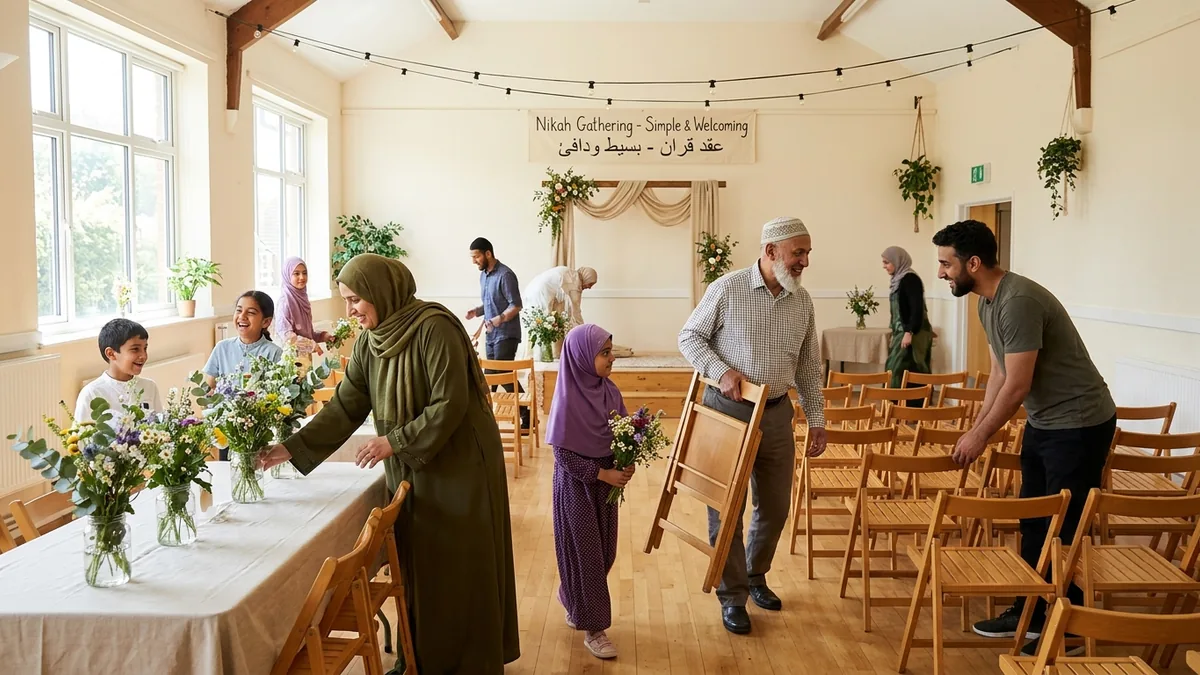
When that is the real problem, simplification is usually wiser than postponement. A smaller gathering, a simpler nikah, or separating the legal marriage from the larger celebration often protects both the couple and their families. If two adults are ready for marriage, it makes little sense to expose the relationship to months of extra strain just to protect appearances. A modest event is far lighter than a heavy atmosphere of delay.
Protect the relationship during the waiting period
Delay increases emotional strain, so boundaries and communication matter more, not less.
When a wedding is postponed, disappointment can easily spill into suspicion, blame or over-attachment. One person may demand constant reassurance; the other may withdraw because every conversation feels loaded. To prevent that, the couple need a calmer communication rhythm and a shared understanding of boundaries while they wait.
Keep communication purposeful. Discuss the obstacle, practical next steps and emotional impact without turning the delay into a daily trial of loyalty. If the couple are not yet married, they should also resist using the frustration of delay as an excuse to become more emotionally or physically entangled than is wise. Waiting is difficult; that is precisely why discipline matters during it.
Know when postponement has turned into avoidance
Repeated delay without movement is usually a message, even when no one wants to hear it.
There comes a point when a postponement no longer protects a good match; it merely prolongs an unclear one. Warning signs include changing explanations, one-sided effort, no review date, families losing coherence in what they say, and a constant request for patience without any visible progress toward resolution.
At that stage the most respectful act may be to stop calling it a delay and ask whether the relationship is still truly moving toward marriage. This does not mean every postponed wedding should end. It means honesty is kinder than indefinite suspension. A person kept in emotional limbo for months is not being protected; they are being drained.
A practical example
Huda and Salman had planned a large summer wedding, but three months before the date Salman’s work contract changed and the couple realised they could not responsibly carry the cost of the event and the first months of married life. At first both families panicked because “postponed” sounded like “cancelled.” The conversations became emotional until one uncle asked the only useful question: are they delaying marriage, or only delaying a style of celebration?
That question changed everything. The couple agreed the match itself was still sound, both families accepted a smaller plan, and they set a six-week review date tied to savings and housing. The new arrangement was not glamorous, but it was honest. By contrast, if Salman had simply said he needed “more time” without being able to explain for what, Huda would have needed to treat the delay very differently. The issue was never the word postponement; it was whether clarity survived it.
Frequently asked questions
Does postponing a wedding usually mean the marriage is failing?
Not necessarily. Many delays are practical and manageable. What matters is whether the reason is concrete, the intention remains clear, and the delay has a structure rather than vague emotional waiting.
Should we keep everything private from extended family?
Not always. You do not owe everyone details, but the key family members involved should hear a consistent, dignified explanation. Silence invites gossip; oversharing invites interference. Aim for enough clarity without drama.
Is it better to do a simple nikah first and celebrate later?
Often, yes, if the couple are genuinely ready and the obstacle is mostly financial or logistical. A simpler lawful step can protect the relationship better than an inflated event that keeps getting pushed back.
When should a postponement make us reconsider the match itself?
Reconsider when reasons keep changing, one person cannot explain what they are waiting for, review dates pass without progress, or the delay is producing confusion rather than practical movement. At that point the problem may no longer be timing.
Delay the event if needed, not the truth
A postponed wedding can still lead to a sound marriage, but only if honesty remains stronger than embarrassment. Name the obstacle, simplify what can be simplified, and protect both hearts from vague waiting. If the issue is real, clarity will usually make the delay easier to bear. If the issue is unspoken doubt, clarity will expose that too, which is painful but still better than drift.
Use this distinction alongside a clear path from serious interest to nikah, and do not confuse postponement with ending a khitbah respectfully. When the pressure comes from a move, work or housing, the article on relocating for marriage without romanticising sacrifice can help you judge whether the delay is solving a real problem or avoiding a harder conversation. Apply the same honesty when planning Hajj or Umrah as a couple affects savings or timing.