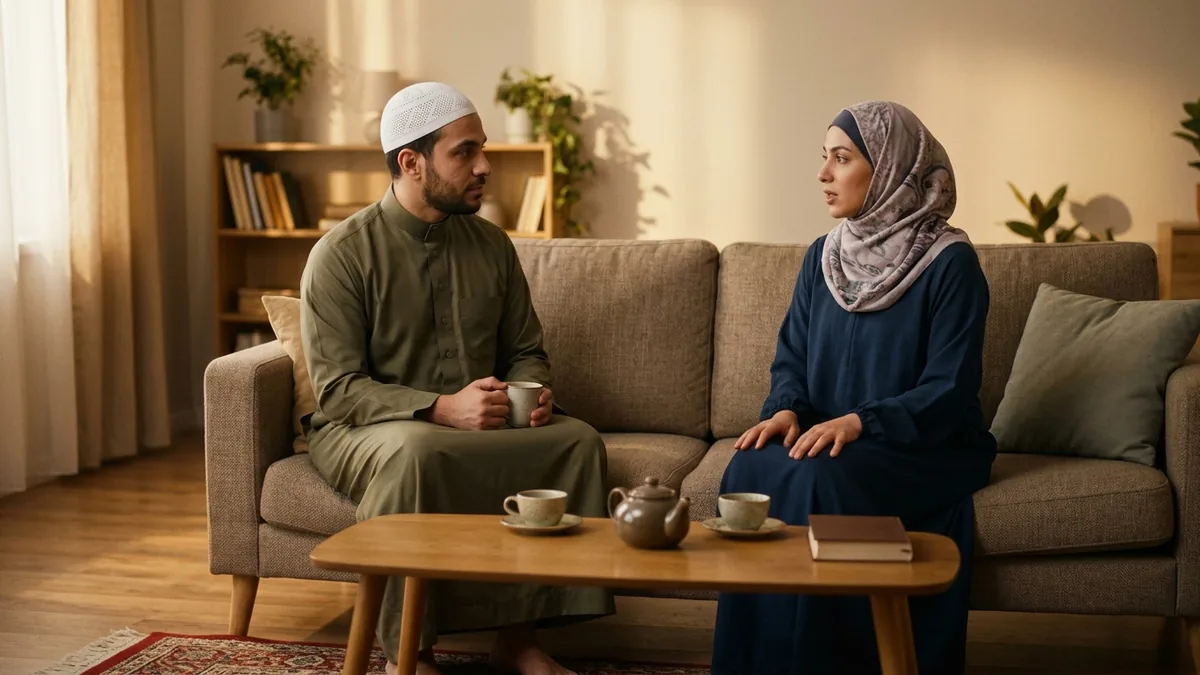
Communication Skills That Protect a Marriage
Most marital problems are not about the issue being argued over, but about how the couple talk when it arises. These are learnable skills, not fixed personality traits.
Couples rarely divorce over the surface topic of their arguments — the money, the in-laws, the chores. They come apart over how they talk to each other when those topics arise. Two people who love each other can still make a home miserable if every disagreement becomes an interruption contest, a court case or a cold silence.
The encouraging truth is that communication is a set of skills, not a fixed personality. A person who was never taught to listen or to disagree kindly can learn, and a couple willing to practise can change the whole climate of their marriage. This guide covers the core skills, why they matter, and how the deen’s emphasis on good speech supports them.
Good marital communication rests on a few learnable habits: listening to understand rather than to reply, speaking about your own feelings instead of accusing, choosing the right time, not expecting your spouse to read your mind, and aiming to repair rather than to win. These skills matter more than being naturally articulate, and they can be built deliberately by any couple willing to practise.
Listen to understand, not to reply
Most people listen only long enough to prepare their rebuttal; real listening is rarer and more powerful.
The single most transformative skill is listening with the goal of understanding your spouse’s meaning, not defeating it. That means letting them finish, reflecting back what you heard before responding, and being willing to discover you misjudged the situation. It is astonishing how many arguments dissolve once a person simply feels genuinely heard.
This is hard precisely because it requires setting down your own case for a moment. But a spouse who feels understood becomes far more able to listen in return, while one who feels steamrolled digs in. Listening is not agreeing; it is the doorway to being able to disagree well.
Speak about yourself, not against your spouse
Naming your own feeling opens a conversation; a “you always” accusation starts a war.
There is a large difference between “I feel alone when evenings pass without us talking” and “you never pay attention to me.” The first is honest and invites a response; the second is a charge that demands a defence. Leading with your own experience keeps the focus on solving a problem together rather than assigning blame.
Words like “always” and “never” almost always inflame, because they turn one incident into a character verdict. Describing the specific situation and its effect on you is both more accurate and far more likely to be heard.
Choose the right moment
The same sentence lands completely differently depending on when it is said.
Serious conversations attempted while one person is exhausted, hungry, rushing out, or already angry are usually doomed no matter how reasonable the content. Raising a hard topic at a calm, private, unhurried time is not manipulation; it is respect for the difficulty of the subject.
If a discussion becomes too heated, it is wise — not weak — to pause and return to it once both of you have cooled down. The deen itself encourages seeking calm rather than acting in the heat of anger, and a short break to protect the conversation is very different from storming off to punish.
Do not expect mind-reading
Unspoken expectations are one of the most common and avoidable sources of resentment.
Many couples fall into the trap of believing that if their spouse truly loved them, they would simply know what they need. This sets a partner up to fail a test they were never told about. Stating a need directly is not unromantic; it is the only fair way to let someone meet it.
Resentment often grows in the gap between what one person assumed was obvious and what the other never realised mattered. Closing that gap with plain words prevents a slow accumulation of quiet disappointments.
Aim to repair, not to win
Treating the relationship as more important than being right is what keeps a marriage warm.
- Notice when you are fighting to win rather than to solve, and consciously shift back.
- Offer and accept sincere apologies without keeping score.
- Use small gestures — a softened tone, a touch, a shared joke — to de-escalate.
- Return to a disagreement calmly rather than punishing with silence.
- Remember you are on the same side of the problem, not opposite sides of a court.
Let good speech be an act of worship
Islam treats how we speak to one another as a matter of character, not just etiquette.
The Qur’an repeatedly links faith with upright, gentle speech and warns against mockery and harsh words. Speaking kindly to a spouse, avoiding contempt, and choosing a good word even in disagreement are not merely communication techniques; they are part of the character the deen asks of us. A gentle word is described as a form of charity.
Framing communication this way lifts it above tactics. You are not only trying to have a smoother marriage; you are trying to treat the person closest to you with the mercy and honesty your faith calls for, especially when it is hardest.
A practical example
Every disagreement between Omar and Sana used to escalate within minutes: she would raise a concern, he would hear an attack and counter with his own grievance, and both would end up defending rather than listening. Nothing was ever resolved, only postponed to the next argument.
The change came from two small habits. Sana began leading with “I feel” instead of “you always,” and Omar began repeating back what he had heard before responding. Neither was a grand technique, but together they turned their fights into conversations. The topics did not change; the way they talked about them did, and that made the marriage feel safe again.
Frequently asked questions
Can communication really be learned, or is it just personality?
It can be learned. Listening, speaking without blame, timing and repair are skills built through practice, not fixed traits. A couple willing to work at them can change the entire climate of their marriage.
What is the single most useful skill?
Listening to understand rather than to reply. Many arguments dissolve once a spouse genuinely feels heard, and it makes the other person far more able to listen in return.
Is it wrong to pause an argument and walk away?
Pausing to cool down and then returning is healthy, and the deen encourages seeking calm over acting in anger. It is very different from storming off to punish with silence, which damages trust.
Why do unspoken expectations cause so many problems?
Because they set a spouse up to fail a test they never knew about. Stating a need plainly is fair and effective; expecting mind-reading breeds a slow build-up of avoidable resentment.
Sources and scope
- Qur’an 33:70 commands believers to speak words that are apt and upright, and Qur’an 49:11 forbids ridicule and insulting nicknames.
- These are principles of character, not a clinical method. Persistent, damaging communication patterns may benefit from a qualified counsellor.
Change the how, and the what gets easier
You will never remove every disagreement from a marriage, nor should you try. What you can change is how the two of you talk when disagreement arrives — and that single shift makes almost every other problem more solvable. Communication is a skill you can keep improving for the whole of a marriage, and it rewards even small, honest effort.
Build it alongside the emotional maturity that lets you stay calm under stress, use it to disagree without contempt or the silent treatment, and let it turn early conversations about expectations into something that draws you closer rather than an interview.