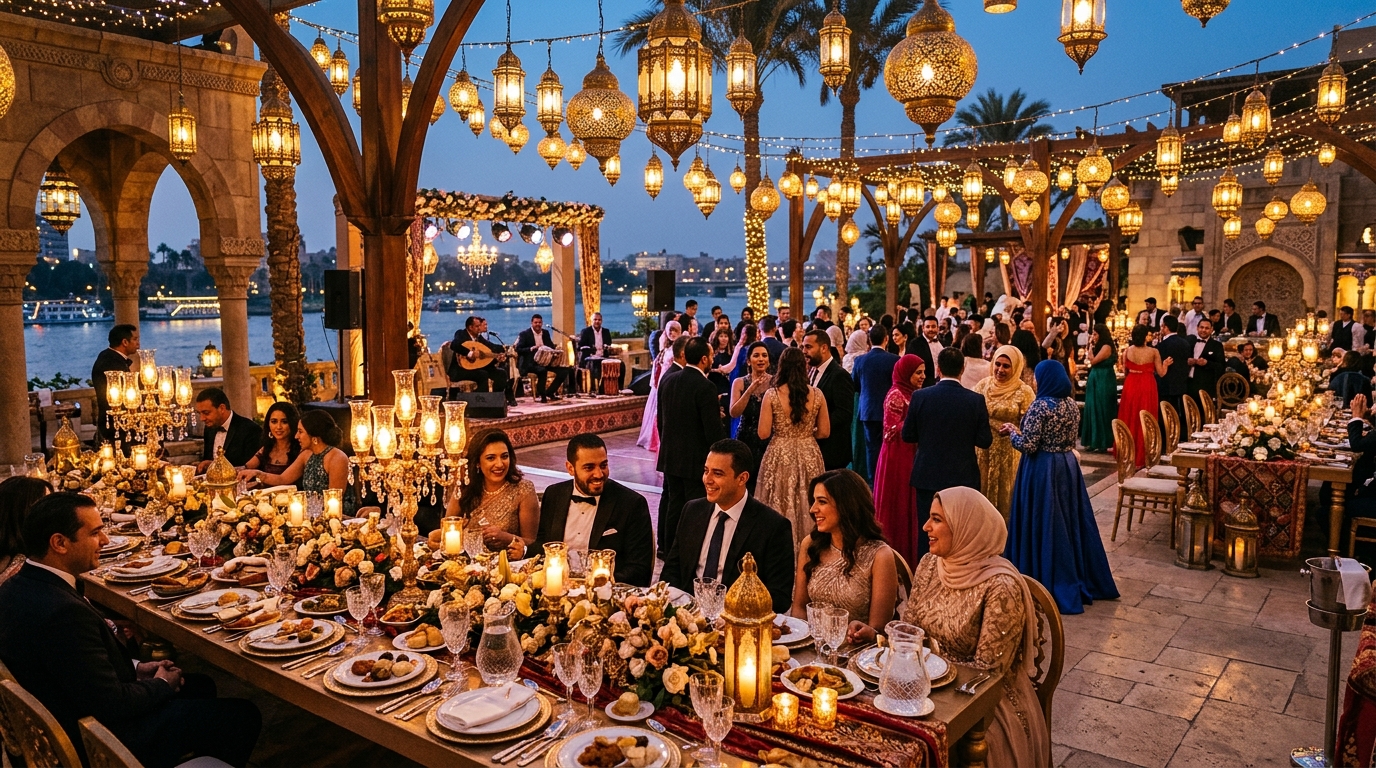
Long tables set for an Egyptian wedding reception under warm light.
The Egyptian Wedding: Katb el-Kitab, Shabka and the Zaffa Explained
Tarek had agreed to everything until the folded paper came out of the drawer. Nobody had told him about the qaima, and the room went quiet in a way he would remember for years.
Tarek had said yes to everything. Yes to the shabka his mother chose, yes to the date, yes to a guest list he had stopped reading at two hundred. Then Mennah's father took a folded sheet of paper out of a drawer, put on his glasses, and began reading aloud a list of furniture, appliances and gold, and Tarek understood that he was expected to sign it.
Nobody had mentioned the qaima. His own parents had married in a village where such things were settled with a handshake. He signed, because the alternative in that room was unthinkable, but he sat in his car afterwards feeling that he had been accused of something he had not yet done.
Mennah's father was not accusing him. He was doing what fathers in Egypt have done for fifty years, for reasons that make complete sense once someone explains them. The trouble is that nobody explains them, and every year couples arrive at that moment cold — which is a good illustration of the wider problem with Egyptian weddings. They are not one event with one set of rules. They are two beginnings, separated by anything from a week to eighteen months, and almost every misunderstanding comes from not knowing which one you are standing in.
The gold that everyone watches
The sequence starts when the families have agreed in principle and the groom's side comes formally to ask. The centre of that visit is the shabka: the gold the groom presents to the bride.
It is worth saying clearly what the shabka is not. It is not the mahr. The mahr is her religious right, written into the contract, and it exists whether or not any gold is bought. The shabka is a customary gift, given before or during the engagement, and over the last thirty years it has become the stage on which two families perform their expectations in front of an audience of relatives.
Two hard truths sit under it. The first is that the amounts have drifted far past what most families can carry, and young men now postpone marriage by years to reach a number that was invented by nobody in particular. The second is that its status after a divorce is genuinely disputed and depends on how it was documented — a large shabka handed over with no record has caused a great deal of grief in Egyptian courtrooms. If it is significant, write down what was given and when. That is not distrust; it is the same instinct that produced the qaima in the first place.
The paper nobody likes and everybody needs
The qaima is an inventory. It lists everything the bride brings into the marital home — furniture, appliances, gold — and the groom signs to acknowledge that these things are hers.
Foreigners find it cold, and plenty of Egyptian men react exactly as Tarek did. But look at what it protects. A bride's family often spends its entire savings furnishing a home in a legal system where proving who owns a bedroom set after a separation is close to impossible. The qaima turns an argument into a document. Written honestly, it is one of the more quietly protective customs in the region.
Written dishonestly, it becomes something else. Inflating a qaima to punish a husband in advance is a misuse of it, and the courts have seen enough of that to be unimpressed. Refusing one outright when the bride's family has genuinely paid for half a home is the same abuse from the other direction. The test is whether the paper describes what actually entered the flat. Sign it in a room where nobody is shouting, and it will do its job.
The day you are actually married
Then comes the katb el-kitab: the contract signed before a ma'zoun, with two witnesses, the bride's guardian involved, and the mahr stated aloud — usually a prompt amount paid now and a deferred amount due on death or divorce.
From that moment they are married. Not engaged, not almost. Many Egyptian couples hold the katb el-kitab as a small gathering with close family and then go on living in their separate homes for months while the flat is finished. Others move in the same week. Both are ordinary, and it is the couple's own agreement — made explicitly, with both families in the room — that decides which.
The deferred mahr deserves more thought than it usually gets. It is a real debt, not a decorative number, and the habit of setting it enormously high to discourage divorce has a consequence people rarely follow through: it becomes the lever used to trap a woman who genuinely needs to leave, because she will be pressured to waive it in exchange for her freedom. A figure that could honestly be paid protects her far better than a figure designed to frighten.
The night: drums, and the guest list that eats the budget
The henna night in Egypt is generally lighter than its Moroccan or Gulf cousins — the bride's female relatives, food, singing, and in many city families it has quietly merged with the modern hen party.
The wedding itself opens with the zaffa, and the zaffa is the sound of an Egyptian wedding: drums, mizmar, singers, sometimes dancers carrying flaming candelabras, escorting the couple through the hall. Twenty minutes of noise and light that will dominate every video anyone takes that night.
It is also one of the largest single costs of the evening, and the range between a small drum group and a full ensemble is enormous. Hotels frequently impose their own supplier, which removes the choice entirely. And if either family has reservations about music or mixed dancing, that conversation belongs weeks earlier and not at the door of the ballroom — a smaller drum-and-vocal zaffa is the middle path most families end up taking, and it keeps the entrance without the argument.
Everything else on the bill follows the guest count. The hall, the catering per head, the photographer, the singer. Families fight hardest over this number and least effectively, because they negotiate it after booking a venue. A hall built for four hundred will be filled with four hundred; the only real decision is made before the deposit, when someone says out loud how many people the couple can actually name.
The flat sets the calendar
Behind all of it sits the flat. Custom expects the groom to provide the home and the bride's family to furnish a substantial part of it, and in Cairo and Alexandria that expectation now collides with prices that left salaries behind years ago.
This is where couples make their most consequential decision, and it is rarely discussed in the open: whether to wait years for the customary standard, or to marry into something smaller and rented. There is no religious requirement for a fully owned, fully furnished flat. That is custom — and custom is negotiable between two families who would rather see their children married than impressive.
The waiting itself is not neutral. Egyptian engagements run long by regional standards; a year is unremarkable, two is common, and that length breeds its own problems. A couple who have signed the katb el-kitab but live apart occupy a strange space — religiously married, socially treated as not-quite — and families differ sharply on what is now permitted. Settle that question early and explicitly, because discovering the disagreement later is how good families end up in bad arguments.
Two years is also long enough for life to change. A job lost, a parent ill, a doubt that grows quietly through a second winter. Long engagements need the same honest check-ins a marriage needs, and if something has genuinely changed it is infinitely better to say so during the engagement than to marry in order to avoid embarrassment. Meanwhile the money leaks: families have been known to spend on the ballroom what would have finished the kitchen. Decide the order of spending before the deposits start, not after.
Coming into this from outside
A foreign spouse meets two systems at once, the family's and the state's, and the paperwork is the easier of the two. Documents take longer than anyone tells you and several of them expire, so ordering everything at once often means ordering half of it twice. Ask the Egyptian consulate for the current list rather than trusting a forum post from three years ago.
The family system is subtler. Expect the shabka and qaima conversations to happen with you present but not always addressed — the negotiation is understood to be between families, and this is not a slight. You are entitled to ask afterwards what was agreed, and you should, in plain words, before anything is signed.
And do not treat the wedding date as fixed until the flat is. In Egypt, the flat sets the calendar and everything else adjusts around it.
What the marriage actually requires
Stripped back, the religion asks for four things: the consent of both, a mahr, witnesses, and the guardian's involvement. That is a complete marriage. The shabka, the qaima, the zaffa, the size of the flat and the four hundred guests are Egyptian custom — some of it protective and wise, some of it merely expensive, none of it obligatory.
Families who can tell the two apart find room to breathe. They keep the zaffa because they love it, write a fair qaima because it protects their daughter, and step out of the shabka race because nobody in that room could afford to stay in it.
Tarek and Mennah have been married four years. The qaima is in a drawer and has never been looked at again, which is what happens to almost all of them. What he remembers now is not the signing but the six months afterwards, when the flat was half-finished and both families had opinions, and he learned that the only conversations that ever helped were the ones held between the two of them first and reported to everyone else afterwards.
If the flat and the shabka are what stand between you and marriage, sit down with the numbers before you borrow — our guide on wedding costs and the debt trap does that arithmetic properly. And if you are still deciding whether this is the right person, assessing character before marriage matters more than any hall you will ever book.
Questions families ask
Is the shabka the same as the mahr?
No. The mahr is the bride's religious right and is written into the marriage contract. The shabka is a customary gift of gold given before or during the engagement. A marriage is valid with a mahr and no shabka; it is not valid without a mahr.
Do we have to sign a qaima?
It is custom, not religious obligation. But it is the main proof of what the bride owns if the marriage ends, so refusing one where her family has genuinely furnished the home leaves her exposed. Write it honestly, listing what actually entered the flat.
Are we married after the katb el-kitab?
Yes. The contract before the ma'zoun, with witnesses and the guardian, is the marriage in both religious and legal terms. The celebration afterwards has no legal effect, whatever its size.
Should the deferred mahr be set very high?
Setting it high to discourage divorce tends to backfire. It becomes the price a woman is pressured to waive if she needs to leave a marriage that has failed. An honest figure that could genuinely be paid protects her better.
How long is a normal Egyptian engagement?
A year is unremarkable and two is common, because the flat and the shabka set the pace. The length itself is not the problem; the problem is a couple who never agreed what is permitted between the contract and the celebration.