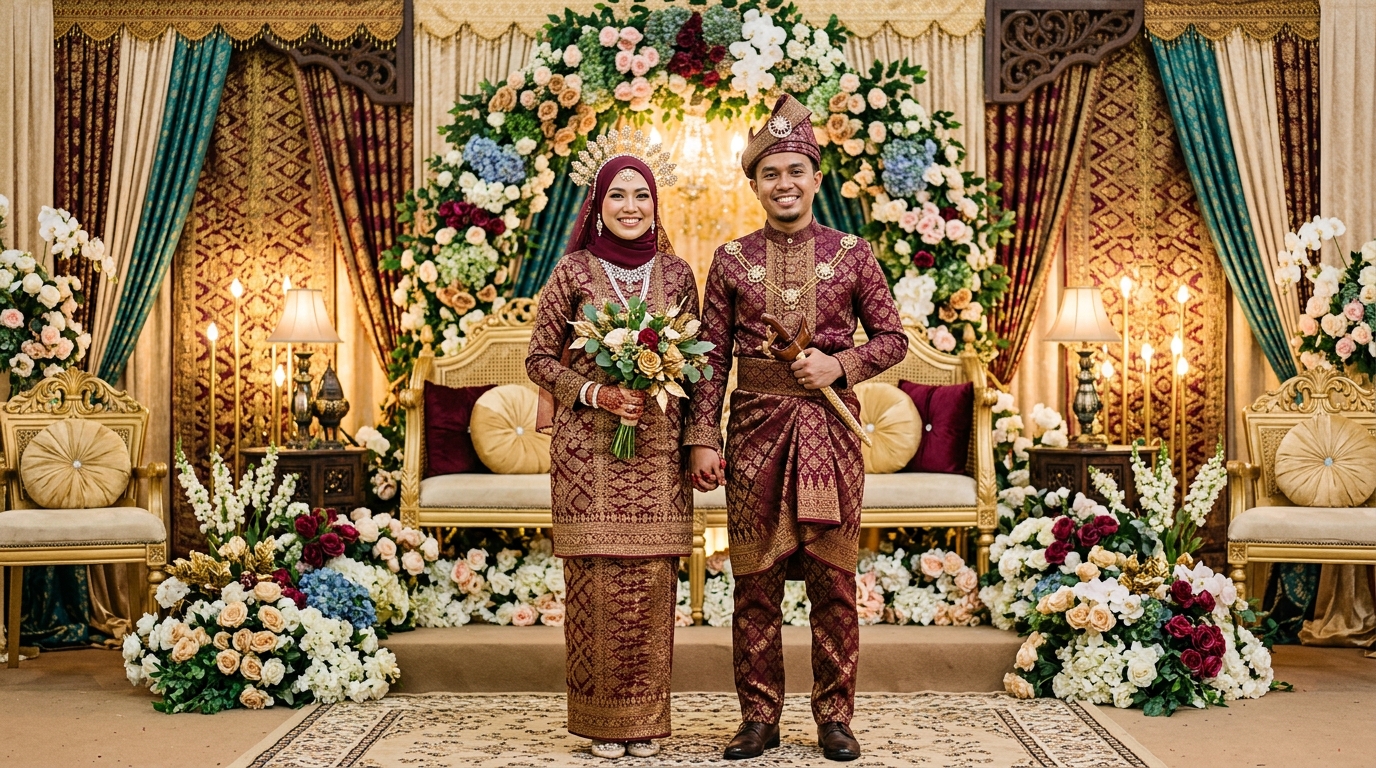
A Malay couple in matching songket seated on the bersanding dais.
The Indonesian and Malay Wedding: Akad Nikah, Hantaran and Bersanding
He had practised it for three weeks. One sentence, one breath, in front of everyone — and if he stumbled, he would have to say it again.
He had been practising it for three weeks. In the car, in the shower, under his breath during meetings.
When the moment came, Faiz took his future father-in-law by the hand, the room went completely silent, and he said the acceptance in one clear sentence without pausing for breath. The witnesses nodded. Somebody exhaled audibly. His mother started crying before the second witness had finished confirming it.
That minute is the marriage. Everything else in a Malay or Indonesian wedding — and there is a great deal of it, spread across weeks — is the celebration built around a single sentence said properly in front of two witnesses.
The question nobody has to answer publicly
It starts long before that, with the merisik: a relative or a trusted intermediary visiting the woman's family to ask discreetly whether she is available and whether the interest would be welcome. Nothing is announced. Nobody is embarrassed if the answer is no.
It is a genuinely humane custom and worth admiring. A refusal costs nobody their standing, because no proposal was ever formally made — which means a young woman can decline without her family feeling publicly rejected, and a young man can ask without staking his reputation on the answer. A great many communities would benefit from importing it.
If the answer is encouraging, the families meet formally for the lamaran or meminang: the proposal is made, gifts exchanged, and the practical matters settled — the mahr, the date, and who carries which costs. A ring or a bracelet is often given, and as everywhere this binds nobody religiously. An engagement is a promise, and either side may still step back without shame.
The trays, and the thing they must not swallow
The hantaran is the exchange of gift trays between the two families, and it is an art form in itself: fabric, perfume, sweets, prayer garments, shoes, sometimes food folded into shapes, all arranged with fans and flowers by someone in the family who has a reputation for it.
The number of trays is agreed in advance and is usually odd, with the groom's side sending one or two more than the bride's returns. This is one of the quiet places where costs escalate, because trays get compared across weddings the way nothing else does. Agree the number early and refuse to compete; a family that adds two trays because a cousin sent twelve has started a race that ends in a number nobody chose.
The mahr — mas kahwin — is a separate matter and must stay separate. It is the bride's right, stated in the contract, in many communities modest by custom and sometimes fixed by the state religious authority, and it is handed over at the ceremony itself. Alongside it there is often an additional gift, and the two should never be confused: the mahr is her right and the gift is a gift. A family that quietly folds the mahr into general wedding expenses has taken something that belongs to her.
The minute itself
The akad nikah is the contract. The guardian offers, the groom accepts in a single clear statement, the witnesses confirm, the mahr is handed over, and the registrar records the marriage.
Two practical points sit underneath the ceremony. The registrar's file is the marriage in the eyes of the state as well as the religion, so make sure it is complete rather than assuming somebody else has dealt with it — the number of couples who discover a missing document years later is not small. And for families living abroad, check what the country you actually live in requires, because a religious ceremony alone frequently gives a wife no legal standing at all, and it is she and the children who carry that gap when it matters.
In many families the akad is followed immediately by the batal air sembahyang: the groom's first touch of his wife's hand, often with a kiss on her forehead. That is the moment the room finally breathes out, and it is usually the photograph the family keeps.
Henna, and the sitting in state
The henna nights — berinai — are held in stages in more traditional families, with the henna applied to the bride's fingertips by relatives who each say a blessing as they do it. The atmosphere is gentler and smaller than the henna nights of North Africa or South Asia; it is closer to a blessing than a party.
Then the bersanding, which is the part everyone photographs: the couple seated together on a decorated dais in matching songket, while relatives come forward one at a time to sprinkle scented water and yellow rice and place a blessing on their hands.
It has deep roots in Malay court ceremony, and families differ on it. Some now shorten it or leave it out, considering parts of it more courtly than religious. Others keep it warmly and see nothing in it but honour shown to a new couple. It is worth deciding deliberately and early rather than by argument on the day, which brings us to the disagreement that runs underneath most of these weddings.
Adat and religion, and how families argue about it
Adat means custom, and Malay and Indonesian weddings carry a great deal of it: the dais, the sprinkling, the ceremonial umbrellas, the sequence of who does what and in which order.
Families disagree about how much to keep, and the disagreement is almost always between generations rather than between the two households. A younger couple influenced by a stricter reading wants a simple akad and a meal. The grandparents want the full adat, and they hear the request to drop it as a rejection of everything they are and everything their mother did before them.
The path that works is the one plenty of families have already found: keep what is affectionate, drop what is genuinely treated as bringing luck or averting harm, and explain the distinction rather than announcing a decision. A grandmother who is asked her opinion gives far more ground than a grandmother who is informed. And the explanation matters more than the outcome — "we love this and we want it, but we do not want to treat it as protection" is a sentence that ends an argument, where "we are not doing that" starts one that lasts a decade.
The kenduri, and the neighbours who cook
The kenduri is the feast, and in Malaysia and Indonesia it is genuinely enormous — often in an open tent or a community hall, running through the middle of the day, with hundreds of guests arriving, eating and leaving in a continuous flow rather than sitting for a set dinner.
The scale is misleading. Because guests come and go, the cost per head is frequently lower than a Western-style seated reception, and the whole neighbourhood is fed. This is the walima doing precisely what it was meant to do: announcing a marriage by feeding people, including the ones who could never afford to feed you back.
The custom most worth admiring, though, is rewang — or gotong-royong: the neighbours and relatives who arrive days early to cook, raise the tent, borrow chairs and run the kitchen, unpaid. It is disappearing in the cities, replaced by caterers, and something real goes with it. A wedding cooked by the people who will be your neighbours for the next thirty years builds a kind of standing that no invoice produces. Where it still exists, feed those people first and thank them by name.
What it costs, and where it slips
The heavy items are the tent and catering, the outfits and the make-up team, the dais and decoration, the photographer, and the hantaran. The guest count is the lever, as it is everywhere — a tent raised for eight hundred will be filled with eight hundred, and every one of them eats.
Two habits keep families sane. Agree the hantaran count early and refuse to escalate it. And keep the wedding money separate from the money for the house, because the couples who spend the deposit on the day regret it inside a year. Our guide on wedding costs and avoiding debt works through the arithmetic.
Marrying into a Malay or Indonesian family from abroad
A few things save a great deal of confusion. The religious authorities in Malaysia and Indonesia have their own procedures and pre-marital courses that couples are expected to complete before the akad, and they take time — ask early rather than three weeks before the date, because these are the things that move a wedding.
In Malaysia in particular, a non-Muslim cannot marry a Muslim under the law without first embracing Islam, and the process is formal and documented. If that is your situation, treat the decision as a matter of belief rather than a wedding formality. It lasts considerably longer than the ceremony does, and entering it for the sake of a date is unfair to everyone including yourself.
And expect the family to be a participant rather than an audience. Questions about your work, your family and where you intend to live are not an interrogation; they are how seriousness gets measured in a society organised around households.
One breath
Faiz got it right the first time, which he will mention for the rest of his life. His cousin, at a wedding the previous year, needed three attempts and has never been allowed to forget it — and that, in its own way, is what these weeks are for: producing the stories that two families will tell each other at every gathering for the next forty years.
One conversation before the date is fixed settles most of the friction: who pays for what, how many guests each side invites, the number of hantaran trays, whether the bersanding will be held, and where the couple will live. Write it down, because two families remembering the same conversation differently is how a happy wedding turns tense.
What the marriage requires underneath all of it is short: the consent of both, a mahr, witnesses, the guardian's involvement, and announcement rather than secrecy. The hantaran, the bersanding, the songket and the size of the kenduri are custom — much of it gracious and worth keeping, none of it a condition of being married. Keep the rewang. Keep the kenduri. And make sure the registrar's file is complete, because that is the part that protects a wife when nobody is celebrating. To compare, read the South Asian Muslim wedding or the Gulf wedding.
Questions families ask
What is merisik?
A discreet enquiry made by a relative or intermediary to the woman's family, before anything is announced, to learn whether she is available and whether the interest would be welcome. Because no formal proposal has been made, a refusal costs nobody their standing.
How many hantaran trays should there be?
The number is agreed between the families in advance and is usually odd, with the groom's side sending one or two more than the bride's returns. There is no religious rule about it, and agreeing early is the only reliable way to stop the count escalating.
Is the mahr the same as the hantaran gifts?
No. The mas kahwin is the bride's right, named in the contract and handed to her at the ceremony. The hantaran is an exchange of gifts between families. Folding the mahr into general wedding expenses takes something that belongs to her.
Do we have to hold the bersanding?
No. It is adat rather than a requirement, and families keep it, shorten it, or leave it out. Decide deliberately and early, and explain the reasoning to the elders rather than announcing a decision on the day.
What should couples abroad check before the akad?
Whether the religious authority requires a pre-marital course or specific documents, how long those take, and what the country they live in requires for the marriage to be legally recognised. A religious ceremony alone often leaves the wife without legal standing.