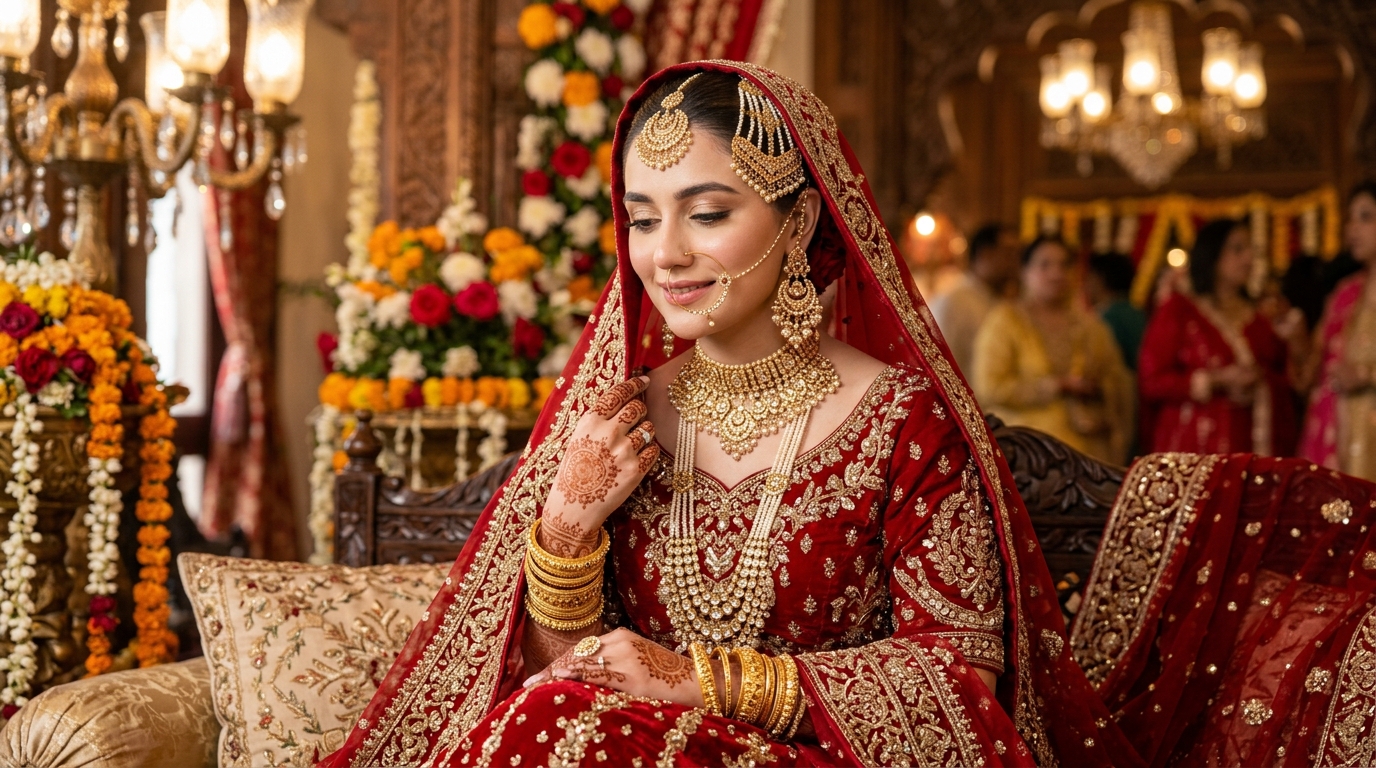
A bride's hands covered in intricate mehndi at a South Asian Muslim wedding.
The South Asian Muslim Wedding: Nikah, Mehndi, Rukhsati and the Dowry Question
Somebody drew a pen through clause eighteen and said, without looking up, that it was not their custom. Ayesha signed anyway. She was nineteen.
Somebody drew a pen through clause eighteen and said, without looking up, that it was not their custom.
Ayesha was nineteen, the room was full, the food was going cold, and three uncles were waiting for her to sign. She signed. Nobody had read the document to her, and she found out eleven years later — in a solicitor's office in Birmingham, on the worst afternoon of her life — precisely what had been crossed out and what it would have given her.
A South Asian Muslim wedding is usually three events across several days: the mehndi, the nikah with the barat, and the walima. Three venues, three sets of clothes, three guest lists, and in most families three separate arguments about money. Inside all of it sits the marriage itself, which takes about four minutes and is recorded on a single sheet of paper that half the people signing it have never read.
The paper nobody reads
The nikahnama is the marriage contract, and in South Asia it is routinely signed in a crowded room under time pressure. It contains clauses that decide the shape of a woman's whole life: the mahr and when it is payable, whether the right of divorce is delegated to the wife, and any conditions the couple choose to add — that she may finish her education, that she may continue working, where the couple will live.
Read every clause before anyone signs. If someone proposes to strike one out, stop the room and ask what is being removed and why, in front of the witnesses. "It is not our custom" is not an explanation of a legal document; it is a way of ending a conversation. Nobody should ever cross out a clause that the bride has not understood.
And write a mahr that is real. A symbolic figure nobody intends to pay is not modesty, it is a debt quietly cancelled before it exists, and the person it belongs to is the only one who loses.
Before that: the rishta
The rishta is the proposal, brought by the families or by someone who knows both households. They meet, enquiries are made, and the couple are given some supervised time to decide.
The healthy version gives both the young man and the young woman real information and a real say. The unhealthy version reduces a person to a list of attributes — height, complexion, salary, caste — and then presses a daughter to accept because the family has already told people. Consent is hers, in the religion, and no amount of social investment overrides it. A family that has announced something prematurely has created its own embarrassment; it has not created an obligation for her.
The mehndi, which everybody enjoys
The mehndi has become the loudest and most enjoyable of the three events in most families: yellow and green clothes, the dholki, songs that get progressively less dignified, dancing, and the henna applied to the bride while everyone teases everyone else.
Families differ on whether it is mixed and on the music, and this is the event where an unspoken disagreement between two households surfaces most reliably. Decide it early and tell people. An aunt who learns on the night that there will be dancing, or a cousin who learns there will not be, is an argument that could have been a phone call in March.
The barat, and the moment nobody gets through dry
The barat is the groom's procession arriving at the bride's family or the hall. The rukhsati is the departure: the bride leaving with her husband, her father and brothers walking her out, a Qur'an held over her head in many families, and the crying that everyone expects and nobody manages to avoid.
It is the heaviest moment of the whole week. Families who rush it to keep a caterer happy regret it afterwards, because it is the only part of the video anyone rewatches. Give it its time.
The walima that follows is the groom's side announcing the marriage with a meal, and it is the part with an explicit basis in the sunnah. What the sunnah asks is that it happens and that people are fed — not that it costs a year's income. A modest walima attended by people who genuinely know the couple fulfils it completely, and if the pressure is coming from relatives rather than from the two of you, the walima between sunnah and extravagance is worth reading before that conversation rather than after it.
The part that needs saying plainly
In much of South Asia, custom expects the bride's family to provide jahez: furniture, appliances, gold, sometimes a car, sometimes cash. In many families it is given freely and considered ordinary. In many others it is demanded, negotiated, and then increased after the engagement, when the bride's family is least able to refuse.
Islam does not ask for this. The obligation runs in the opposite direction — the mahr is given by the husband to the wife, and it is hers. A demand made on a bride's family as a condition of marriage has no religious basis whatsoever, and dowry demands have caused documented harm across the subcontinent for generations: debt, marriages delayed for years, daughters spoken of as a cost, and in the worst cases far more than that.
What families can actually do is simple and it works. Refuse to make demands. Refuse to accept them. And say so early and publicly, at the rishta stage, so that nobody discovers your position at a moment when refusing it would break the engagement. Gifts a father gives his daughter freely, which remain hers, are a completely different matter. The line is whether anybody was asked.
Three events, and the money they consume
Three events multiply everything: three halls, three caterers, three sets of clothes, and a guest list that swells because each side invites its own network to each occasion.
The families who keep control do one of two things. They combine the nikah and the walima into a single day, which is now common enough to be unremarkable. Or they cut the guest list to people who could name the couple without checking the invitation. Both leave money for the home, which is where it matters twelve months later. Our guide on wedding costs and avoiding debt works through the arithmetic without moralising.
The warning that matters most in Britain
This paragraph is the most practically important one in the article for families in the West, and it is the one most often waved away.
In several countries — England and Wales in particular — a nikah performed in a venue that is not registered for marriages does not create a legally recognised marriage. The couple are married in the eyes of the community and unmarried in the eyes of the law. They discover it years later, at a separation or a death, when the wife finds she has none of the rights a wife has: not to the home, not to a share of what was built together, not to a widow's protection.
Do both. The civil registration and the nikah, ideally on the same day. If a mosque tells you the civil ceremony is unnecessary, ask whether that building is registered for marriages — and register the marriage anyway. Ayesha's clause eighteen would have helped her. A civil registration would have helped her far more.
The games, and the house you move into
South Asian weddings are full of organised teasing: the bride's sisters hiding the groom's shoes and refusing to return them without payment, the milk brought to him with a price attached, the ring hunted for in a bowl of water to see who will supposedly rule the house.
None of it is religious and all of it is optional, but it does something useful. It forces two sets of young relatives to interact, laugh at each other and become familiar, which is exactly what two families joining need to do. The households who skip every game and keep only the photographs frequently find that the two sides never really met. Keep the games kind, though — the line is easy to see when you look for it: teasing that everybody including the target enjoys is the tradition, and humiliation dressed as tradition is not.
Then there is the house. In a great many South Asian families the couple begin married life in the groom's family home. It is normal, often affordable, sometimes genuinely warm — and it is the single most common source of strain in the first two years. What helps is deciding the terms before the wedding rather than discovering them after: how long it is meant to last, which space is theirs, who manages the household money, and how decisions about the couple get made. A husband who never says any of this to his mother, and a wife who never says it to her husband, is the classic pattern behind a marriage that curdles without anyone naming a cause. Say it kindly, early, with both mothers present.
What Ayesha tells her daughters
One conversation with both sets of parents settles most of it: who pays for what across the three events, how many guests each side may invite, whether there will be music and whether the events are mixed, where the couple will live and for how long, and a ceiling nobody exceeds. Write the answers down, because almost every pre-wedding conflict in a South Asian family begins with two households assuming different numbers and neither of them saying so.
What the marriage requires is short: the consent of both, a mahr, witnesses, the guardian's involvement, and announcement rather than secrecy. The mehndi, the barat, the three events and the jahez are custom — a great deal of it joyful and worth keeping, and one part of it worth ending.
So keep the dholki. Give the rukhsati its time. Read the nikahnama, every clause, out loud if necessary, with the bride in the room and unhurried. Register the marriage where you live. And let no family begin a daughter's married life by asking her father for furniture. To compare with other regions, read the Gulf wedding or the Egyptian wedding.
Questions families ask
What is in the nikahnama and why does it matter?
It records the mahr and when it is payable, whether the right of divorce is delegated to the wife, and any conditions the couple add. Clauses are frequently struck out in the room without explanation. Read every one before signing, and never allow a clause to be removed that the bride has not understood.
Is jahez required in Islam?
No. The obligation runs the other way: the mahr is given by the husband to the wife and belongs to her alone. A demand on the bride's family as a condition of marriage has no religious basis. Gifts a father freely gives his daughter, which remain hers, are a different matter entirely.
Is a nikah legally valid in England and Wales?
Not on its own if the venue is not registered for marriages. The couple are then married religiously and unmarried legally, which leaves a wife without rights to the home or to a share of what was built together. Have the civil registration as well, ideally the same day.
Can the three events be combined?
Yes, and it is increasingly ordinary. Many families now hold the nikah and walima on a single day, or shorten the guest list to those who actually know the couple. Both approaches leave money for the home.
Should the couple live with the groom's family?
It is common and can work well, but it is also the most frequent source of strain in the first two years. Agree in advance how long, which space is theirs, who manages household money, and how decisions are made — with both mothers present when it is said.