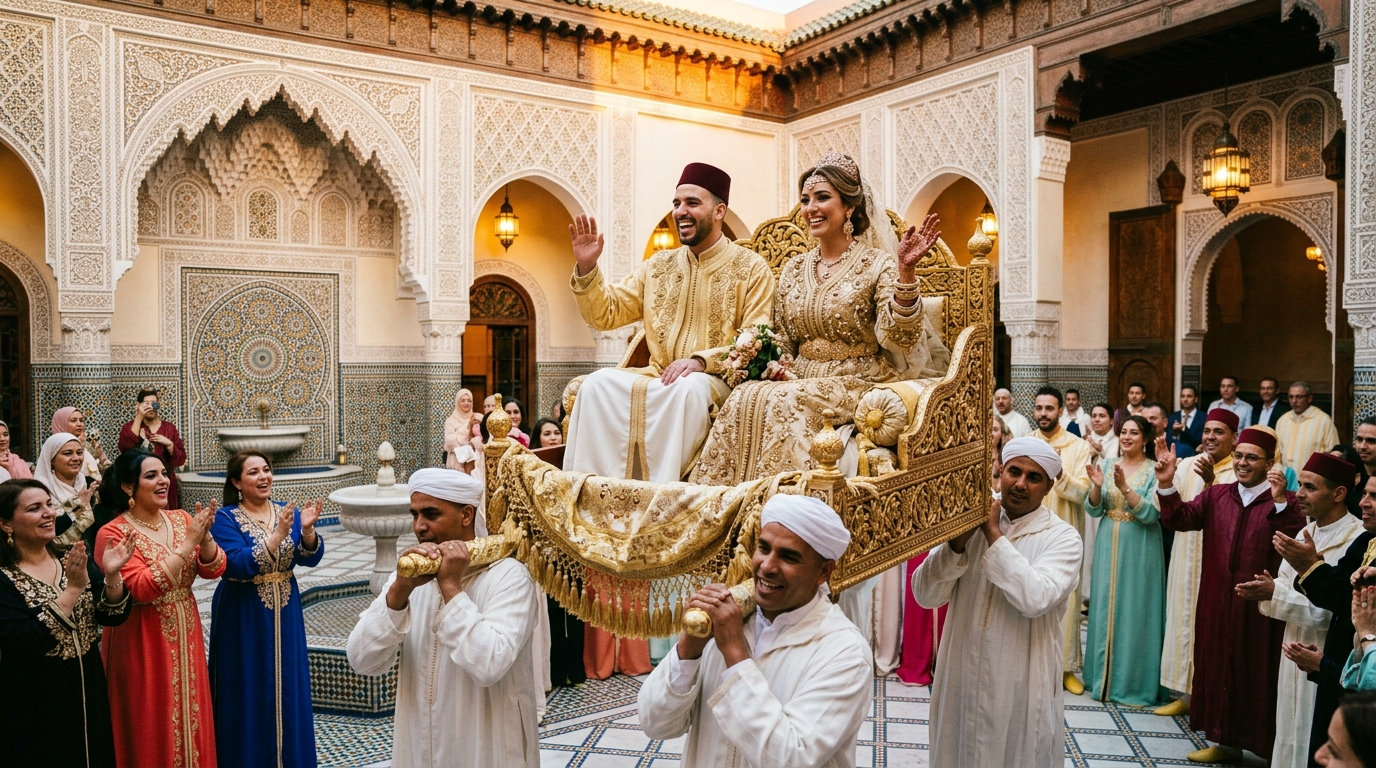
A Moroccan bride and groom in embroidered caftans standing in a tiled courtyard.
The Moroccan Wedding, Step by Step: From Khotba to Amariya
The afternoon Salma became a wife, she ate cake in a living room with twelve people and then went home to her parents. The party was still eleven months away.
The afternoon Salma became a wife, she ate cake in a living room in Casablanca with twelve relatives, signed her name twice, and went home to her parents' flat. The dress was ordinary. Her mother cried anyway. Younes went back to work the next morning, and for the next eleven months the two of them were husband and wife who did not live together, did not tell strangers, and were waiting for a hall to be free in June.
Her English colleague found this baffling. When are you getting married? I already am. Then what is happening in June? A wedding, Salma said, and understood as she said it how strange that sounds to anyone who has not grown up with it.
Ask a Moroccan family when the wedding is and you will rarely get a date. You will get a season. What outsiders call the wedding is in fact a sequence of separate events, spread across months, and each one does a different job: asking, agreeing, signing, celebrating, and finally moving the bride into her new home. Knowing which stage does what is the difference between a family that spends what it can afford and one that spends four years paying for a single night.
The visit with the sugar cones
It starts with a visit. The groom's father, his mother, usually an uncle or an older brother, arriving at the bride's home with sugar cones, milk, dates and a tray of pastries. This is the khotba, the formal request, and the symbolism is old and unfussy: sweetness for the life ahead, milk for a clean and generous start.
Everyone concentrates on the tray. What matters is the conversation. The two families are sizing each other up, often for the first time, and underneath the tea the practical questions begin to surface — where the couple will live, what each side is expecting to provide, roughly when all this might happen. Families who answer those questions honestly in that first sitting save themselves a year of quiet resentment later.
Nothing is binding. An engagement in Islam is a promise to marry, not a marriage, and either side may still step away. That deserves saying plainly, because some families treat the khotba as a door that locks behind you and press a hesitant son or daughter to keep walking. That pressure is cultural. It has no religious weight, and a young woman who changes her mind between the khotba and the contract has done nothing wrong. If anything, she has done everyone a favour by doing it now.
The room where the marriage actually happens
The mlak is what married Salma. Elsewhere it is called the katb el-kitab or the milka; in Morocco it is recorded by two adouls, the traditional notaries, who write down the agreement and state the mahr aloud. From that moment the couple are husband and wife in the eyes of the religion and of Moroccan law both. There is no second, more official wedding waiting later in the year.
Foreign spouses trip on this constantly, and so do young Moroccans raised abroad. They assume the party is the wedding and the contract is a formality, when the truth is precisely reversed. The party is the optional part. Every element that makes a marriage — the consent of both, the mahr, the witnesses, the guardian's involvement — is already complete in that living room, and everything that follows is celebration.
The mahr is settled here too, and it is the bride's alone: not her father's, not a payment to her family, not a deposit against divorce. What has crept in over the last two generations is inflation. A mahr set so high that the marriage is postponed for years serves nobody, and the tradition itself pushes the other way — ease was encouraged, extravagance was not. A woman who accepts a modest mahr from a man who is genuinely at the start of his working life has not been shortchanged; she has bought a marriage that starts without debt, which is worth considerably more than a number written on a page.
One question is worth asking out loud before the ink dries: are we living together after this, or not? Some families expect the couple to move in immediately. Others expect them to wait for the celebration, months later, and would be scandalised by anything else. Both are normal. Assuming and being wrong is where the first real fight of a marriage tends to come from.
The henna, the neggafa, and the seven dresses
Then comes the part everyone photographs. A few nights before the celebration, the women of both families gather for the henna night. A neqqasha works on the bride's hands and feet in patterns that take hours, there is food and singing, and in its older form the married women of the family use those hours to tell the bride things nobody says in front of men.
Practical matters intrude even here. Good henna needs six to eight hours on the skin to darken properly, so the night runs late whether or not anyone planned for that. In summer every family in the neighbourhood is competing for the same few pairs of hands, so the neqqasha is booked weeks out. And a patch test days beforehand is not fussiness — the so-called black henna sold in some markets contains PPD, it burns skin, and it is still on sale.
The celebration itself belongs to the neggafa. Her job has no clean equivalent anywhere else: she supplies the outfits, dresses and redresses the bride through the night, manages the jewellery and sets the rhythm of the whole evening. Tradition says seven dresses, each one carrying a region or an era — the green Fassi caftan, the silver of the Souss, the white takchita, the Saharan robe — though most families now stop at three or four. Between each change the bride is presented to the room again.
And then the amariya: the bride, often with the groom beside her, lifted onto an ornate circular platform and carried in on the shoulders of four men. It is unashamed theatre. It is also the photograph that will sit in a frame in someone's hallway for the next forty years, which is exactly why nobody argues about paying for it.
The eleven months in between
Between the contract and the celebration sits a gap that nobody describes to couples in advance, and it is where most of the difficulty lives. A common shape: khotba, then one to three months to the mlak while the paperwork and the mahr are settled, then anywhere from three months to two years before the party — the delay almost always driven by money, or by finishing and furnishing a home.
Two things go wrong in that stretch. The first is that two people who are religiously married but sleeping in separate houses find the wait far harder than they expected, and no one prepared them for it. The second is quieter and more expensive: the budget creeps. A relative suggests a bigger hall. Another mentions the photographer her daughter used. Each suggestion is small, none of them is refusable in the moment, and by spring the number has doubled.
The old division of costs was clean — the groom's side carried the mahr, the gold, the home and its furniture; the bride's side carried the trousseau and often the henna night. It still holds in many families, but far less rigidly than a generation ago, and pretending it is fixed when it is not is precisely where the arguments start. Today the two families frequently split the hall and the caterer, and it is increasingly the couple themselves who carry the largest share. Which model a family follows matters much less than saying it out loud, in front of both sets of parents, before a single deposit is paid. A hall booked on an assumption is the most reliable source of pre-wedding conflict there is.
Where a foreign spouse is involved, count in months rather than weeks. Consulate documents expire, so ordering them too early costs as much as ordering them too late.
What families are quietly letting go
Costs have climbed to the point where couples begin married life owing money, and a visible number of families have started pushing back — not by announcing a principle, but by trimming. Three dresses instead of seven, because the neggafa charges by the outfit and nobody remembers the fifth one. The henna and the celebration folded into a single weekend instead of three separate nights. A guest list built from people who actually know the couple rather than an entire extended network. And gold that is rented rather than bought, which families now say out loud instead of pretending.
None of it touches the marriage. The mlak was the marriage. Everything after it is a celebration, and a celebration is meant to sit inside what a family can carry — the walima is a sunnah of generosity, not of ruin. Writing the ceiling on a piece of paper before booking anything is unglamorous and it works, because a hall is booked once and a debt is repaid for years. Our guide on wedding costs and the debt trap works through the actual numbers with you.
It also helps to know which parts are religion and which are Morocco. The religion asks for consent, a mahr, witnesses and the guardian's involvement. That is the marriage, complete. The seven dresses, the amariya, the sugar cones and the henna are culture — beautiful, worth keeping, and entirely optional. Knowing the difference does not make anyone less Moroccan. It makes them able to refuse the one item that would have cost two years of savings without feeling they have failed their family.
June, eventually
Salma's celebration happened, more or less as planned, with four dresses instead of seven and a guest list her mother described as brutal. The amariya went ahead, because her father had waited his whole life to see it and she was not going to take that from him.
What she says now, two years on, is that the eleven months mattered more than the night. That was the stretch where she and Younes learned how the other handled money, and pressure, and a mother-in-law with opinions about curtains. The party was one evening and a very good photograph. The marriage had already been running for almost a year by the time anyone clapped.
Which is the thing worth carrying out of all this. If you are still at the earlier stage — deciding, rather than planning — our guide on assessing character before marriage is the more useful read, and if you have not yet met anyone, you can create a profile and begin properly.
Questions families ask
Are we married after the mlak, or only after the party?
After the mlak. The contract, witnessed and recorded by the adouls, is the marriage in both religious and Moroccan legal terms. The celebration that follows carries no legal or religious weight — it is a party, however large.
How long does a Moroccan wedding take from start to finish?
Commonly six months to two years. One to three months from khotba to mlak, then a further three months to two years to the celebration, with the gap set almost entirely by money and by the readiness of the couple's home.
Does the bride really need seven dresses?
No. Seven is tradition, not obligation, and most families now use three or four. The neggafa charges per outfit, so this is the single easiest place to reduce cost without anyone feeling the evening was diminished.
Who pays for a Moroccan wedding?
Traditionally the groom's side covers the mahr, gold, home and furnishings, and the bride's side the trousseau and henna night. In practice families now share the hall and catering, and couples increasingly pay the largest share themselves. What matters is agreeing it explicitly before any deposit is paid.
What is the amariya?
An ornate circular platform on which the bride, often with the groom, is carried into the hall on the shoulders of four men. It is the centrepiece of the evening and, for most families, the photograph that outlives everything else about the night.