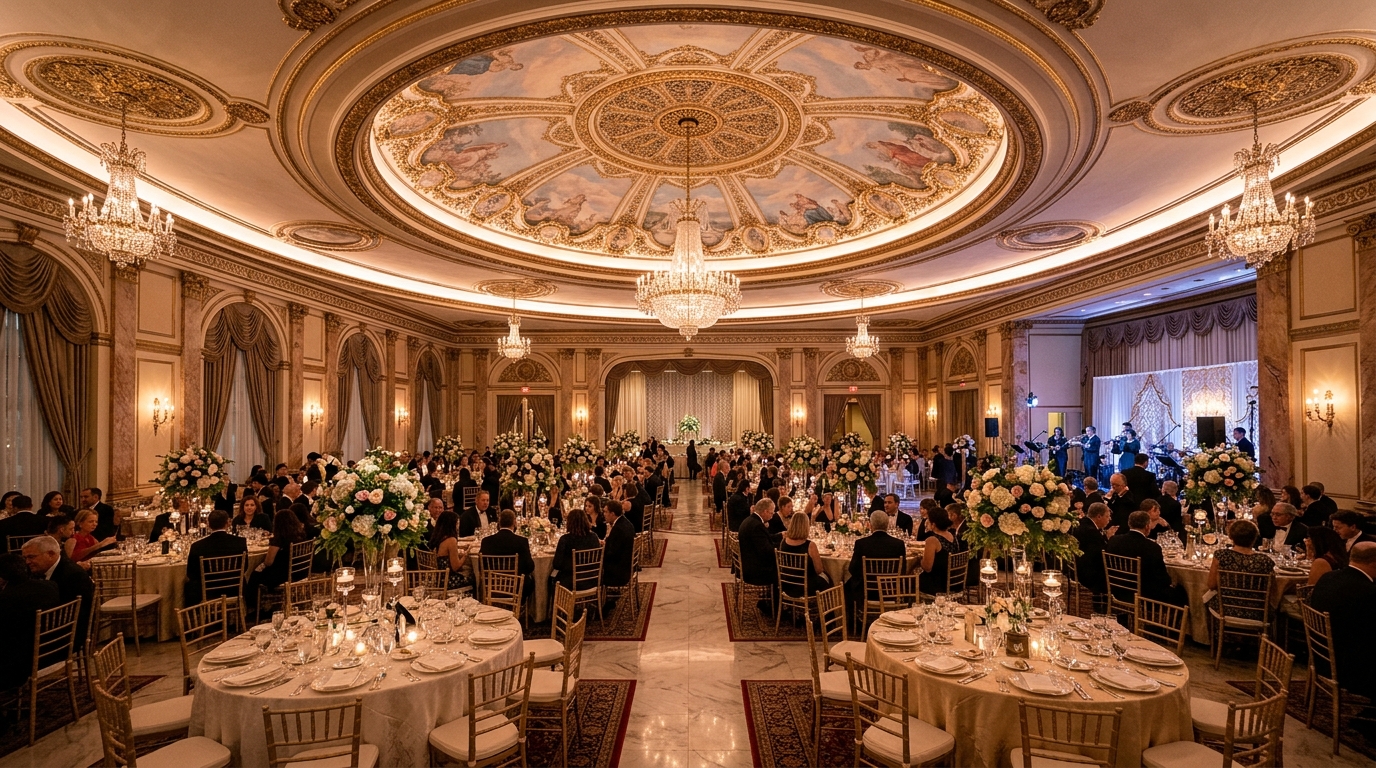
A brightly lit wedding kosha decorated with white roses in a Gulf wedding hall.
The Gulf Wedding: The Milka, the Long Wait and the Women's Hall
Munira had been married for eight months and still said goodnight to her husband at her father's front door. Nobody had told her the waiting would be the hard part.
Munira had been married for eight months, and every visit still ended the same way: Faisal walking her to her father's front door, saying goodnight in front of whoever happened to be in the hallway, and driving back to his family's house on the other side of the city.
They had signed the contract in a living room the previous autumn, with a shaykh, her father, two witnesses and a plate of dates. Religiously and legally they were husband and wife. Socially they were something else entirely — a couple with a wedding hall booked for the following spring and a house that still needed a kitchen.
Her cousin in London found the whole arrangement incomprehensible. If you are married, why are you not married? It is the single most misunderstood feature of Gulf wedding traditions, and the source of most of the strain that couples there quietly carry. The day two people become husband and wife is almost never the night everybody photographs.
The quiet room where it actually happens
The milka — called the milcha in the Emirates and Kuwait, or simply the katb al-kitab — is the writing of the marriage contract. A ma'zoun or the court records it, the bride's guardian takes part, two witnesses attend, the mahr is written down, and the couple sign.
From that moment they are married. Not engaged, not nearly. And yet in most Gulf families both of them go on living in their parents' homes, sometimes for a year or more, until the wedding night.
This is a stage with no published rules, and every family draws its own line. Some treat the couple as fully married from the next morning and think nothing of them travelling together. Others behave as though nothing has changed until the celebration. The mistake that causes real damage is assumption. Ask, plainly, before the contract is signed: after the milka, what changes and what does not? One awkward conversation buys a year of peace, and couples who skip it spend that year discovering the answer through a series of small humiliations.
What comes before the milka has changed more than the milka itself. A generation ago two people might exchange three sentences before signing. Today most families arrange a proper viewing — the shoufa — with relatives present, followed by supervised conversation and phone calls, so that the istikhara is prayed while the door is genuinely still open rather than after the deposits are paid. That is a healthy shift, and it is worth insisting on if your family is in a hurry.
The year in between
The wait has practical causes. The house is still being finished. The good halls are booked for the season when everyone is home. One of them is completing a degree. The money for the celebration is still being gathered.
Two things go wrong in that year, and both are predictable. The first is drift: two people married on paper, living in separate houses, meeting only in the presence of others, waiting for permission to begin. It is a strange suspended place and nobody prepares them for it. The second is the budget, which grows every time a relative suggests an addition — a bigger hall, a better singer, a photographer someone's daughter used.
Couples who come through it well tend to do two unremarkable things. They fix a date rather than a season, and they agree the ceiling in the same conversation in which they agree the date. A wedding permanently scheduled for "next year" turns, quietly and reliably, into resentment between two people who are already married.
The mahr, the gold and the dazza
The mahr is written into the contract and belongs to the bride alone. In parts of the Gulf it has climbed to figures that keep young men unmarried into their thirties, and there is now a visible movement against it: families announcing a ceiling, fathers asking for little and saying so with pride rather than embarrassment. That direction has the whole tradition behind it — ease in the mahr was encouraged, never extravagance.
Alongside it comes the gold, and in several Gulf countries the dazza: gifts sent from the groom's family to the bride before the wedding — perfume, oud, abayas, fabrics, jewellery, sometimes arranged and displayed for the women of the family to see.
One practical note that saves grief later. Whatever gold is given, and whenever it is given, write down what it was. The status of gifts if a marriage ends badly depends entirely on what can be evidenced, and memory is not evidence. This is not suspicion; it is the same protective instinct that produced the written inventory in Egypt and the recorded contract everywhere else.
The night, in two halls
A few nights before the wedding, the women gather for henna. The bride wears a traditional dress rather than white — an embroidered thob al-nashal in the Emirates, or a green or gold gown elsewhere — and the room fills with oud and bakhoor. There are drums, the old songs that grandmothers still lead, and hours of talk while the henna is drawn.
Most brides say afterwards that the henna night was the part they actually enjoyed. It is smaller, it is family, and nobody in the room is performing for four hundred guests.
The wedding itself is separate: women in the hall, men in a majlis or a tent. This is what surprises outsiders most, and it deserves an honest description rather than a euphemism. The women's hall runs late — guests from nine or ten, the bride entering close to midnight, dinner at one or two. The entrance is the centre of the evening: a very slow procession down a lit walkway to the kosha, the raised seat where the bride sits, sometimes to a singer, sometimes to unaccompanied vocals in families who avoid instruments.
Inside that hall the women are uncovered. That is the entire reason the door is closed, and it is why phones are collected at the entrance, stickers are placed over cameras, and halls now employ someone whose only job is to stop people filming.
If you are the bride, do not leave this to chance. Put it on the invitation. Ask two cousins to watch the room. If you want photographs, hire a woman photographer and agree in writing where the images will be stored and who may see them. One phone in one hand undoes the privacy of every woman in that hall, and it has happened often enough that families no longer treat the request as rudeness.
The men's side, and the entrance
The men's majlis is usually shorter and plainer: coffee and dates, then dinner, and in many families the ardha or the yowla — the line of drums and canes, which carries a great deal of dignity and very little noise about itself.
Late in the night the groom enters the women's hall with his father and brothers. The entrance is announced first so the women can cover, then the couple sit together on the kosha for the photographs the family will keep. In some families the night ends there; in others that is the moment the couple leave together, and the marriage that has existed on paper for a year finally begins in practice.
What families are quietly changing
The heavy costs are the hall, the kosha and flowers, the singer, the photographer and video, the gold and the dress. Together they can equal a young man's salary for a year, often more, and the reaction against that has become respectable rather than shameful.
Mass weddings organised by charities and family associations now marry dozens of couples in one hall at a fraction of the cost, and in most communities they carry no stigma at all. Other families hold the milka and then a family dinner instead of a full hall, putting the difference into the home. Others shrink the guest list, which is the only number that moves every other number. And renting the dress and the jewellery rather than buying them has become common enough that nobody bothers to hide it.
None of this touches the marriage. What the religion requires is short — the consent of both, a mahr, witnesses, the guardian's involvement, and that the marriage be announced rather than hidden. The kosha, the singer, the four hundred guests, the weight of the gold and the length of the wait are custom: some of it warm and worth keeping, some of it simply expensive. Before signing anything, our guide on wedding costs and avoiding debt is worth an hour, because a loan taken for one night is repaid across years of a marriage that has to survive it.
Marrying into a Gulf family from outside
Foreign spouses meet two systems at once. Several Gulf countries require a citizen to obtain official permission before marrying a non-citizen, and the conditions change; ask the relevant ministry or embassy directly rather than trusting a forum thread, and start early, because this is measured in months rather than weeks.
Expect the family to be a participant rather than an audience. Questions about your family, your work and where you intend to live are not an interrogation — they are how seriousness is measured in a society organised around households rather than individuals. And expect the wedding to be theirs as much as yours: in a hall of four hundred people, it is the two families who are being seen.
Ask directly, before the contract, where you will live and how often you will travel to your own country. In a family-centred society that decision is made once and lived with for a very long time.
Spring, eventually
Munira's wedding happened in April, sixteen months after the contract. The hall was smaller than her mother wanted and the guest list was cut twice. The henna night was the part she remembers, and the phones were collected at the door by a cousin with an unusually firm manner.
What she says now is that the sixteen months taught her more about Faisal than the evening did. They had learned how the other argued, how each family handled money, and what it felt like to be patient with someone you had already promised yourself to. The night was a photograph. The waiting was the marriage, starting quietly, before anyone clapped.
If you want to see how differently the same contract is dressed elsewhere, read the Moroccan wedding step by step or the Egyptian katb el-kitab. The nikah is identical in all three. Everything around it is a choice, and choices can be made smaller.
Questions families ask
Are we married after the milka?
Yes. The contract, recorded with the guardian and two witnesses, is the marriage religiously and legally. The celebration months later has no legal effect — which is precisely why the question of what changes in the meantime must be asked out loud.
Why do couples wait so long between the contract and the wedding?
Usually the house, the hall and the money. Six months to two years is normal. The wait becomes damaging when there is no fixed date, so agree a date and a budget ceiling in the same conversation.
Why are phones taken at the door of the women's hall?
Because the women inside are uncovered. Collecting phones, covering cameras and hiring a woman photographer are how the privacy of every guest is protected, and the request is normal rather than impolite.
What is the dazza?
Gifts sent by the groom's family to the bride before the wedding — perfume, oud, abayas, fabrics and jewellery — sometimes arranged and displayed for the women of the family. It is custom, not a religious requirement, and it is separate from the mahr.
Are mass weddings looked down on?
In most Gulf communities, no. Group weddings organised by charities and family associations have married a great many couples who would otherwise still be saving, and families increasingly speak about them with pride rather than apology.