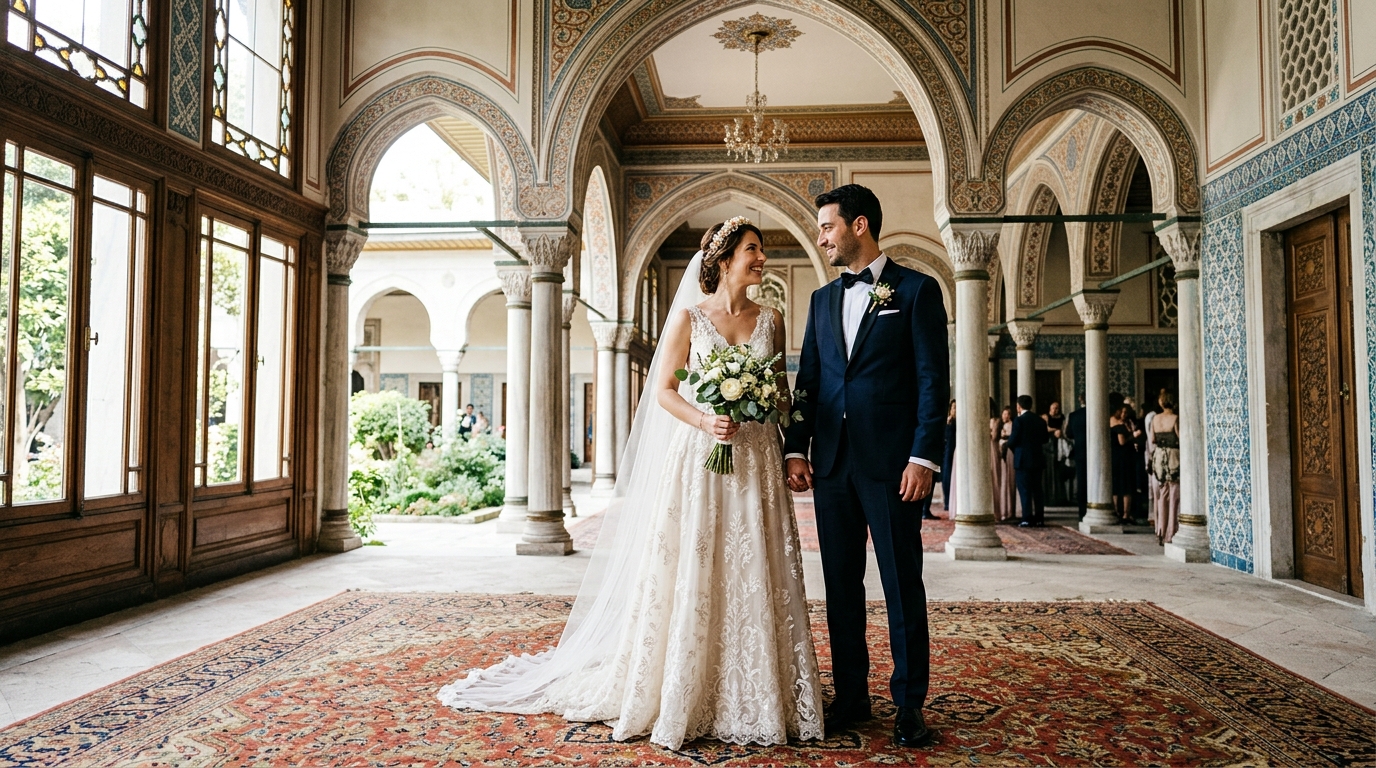
A Turkish bride in a red veil during the kına gecesi henna night.
The Turkish Wedding: Söz, Nişan, Kına Gecesi and the Nikah
Emre drank the whole cup without changing his face. His future mother-in-law had put two spoons of salt in it, and the room was waiting.
Emre drank the whole cup without changing his face.
Elif's mother had put two full spoons of salt in it instead of sugar, as her own mother had done to her father, and the room went quiet the way rooms do when everybody is enjoying something they are pretending not to watch. He finished it, set the cup down, said the coffee was excellent, and his future father-in-law laughed loudly enough to end the tension.
That is a Turkish wedding in miniature: a small ritual with a name, a test that everyone knows the answer to, and a room full of people who need to see a young man behave well under mild public pressure. What follows is the whole sequence — and one rule in the middle of it that is not a custom at all, but a law, and the thing Turkish families abroad most often get wrong.
The word, and the promise that is not a marriage
The visit itself is the kız isteme, the asking. The groom's father and an elder speak on his behalf, using the traditional phrase that asks for the daughter by the command of God and the word of the Prophet. The answer may come that evening or after a pause for enquiries — and a pause is a good sign, because it means the family is weighing a decision rather than being carried along by the occasion.
Then comes the söz, the word: the informal promise, a small gathering of both families. And after it the nişan, the engagement proper, with the two rings tied together by a red ribbon that an elder cuts, and a party that in some regions has grown to nearly the size of the wedding itself.
Neither of these marries anybody. An engagement is a promise, and either side may still withdraw however much has already been spent — a point worth saying aloud in families where a broken nişan is treated as a scandal instead of an honest decision made in time.
The order that is not a custom but a law
Here is the part that catches families out, and it catches them out most often abroad. In Turkey, only the civil ceremony before an authorised registrar creates a legally recognised marriage. The religious ceremony — the imam nikah — comes afterwards. A couple who have had only the religious one are, as far as the state is concerned, not married at all.
That reaches much further than paperwork. Inheritance, a child's registration, residence, pensions, and a wife's rights if the marriage ends all rest on the civil record. A woman who has been a wife for twelve years in the eyes of her family and no years in the eyes of the state discovers this at the worst possible moment, usually in an office, usually while someone explains that they are very sorry but there is no file.
The solution costs nothing: do both, in the right order, in the same week, and keep the certificate somewhere safe. Nothing in the religion asks a man to leave his wife unable to prove her own marriage — the tradition insists a marriage be announced rather than hidden, and the registry is simply the modern form of that announcement.
The mahr, meanwhile, belongs to the bride in the religious contract, and it should be a figure that will genuinely be paid rather than a symbolic number nobody intends to honour.
The night everybody cries
The kına gecesi is the emotional centre of a Turkish wedding, and it is not a light-hearted party. The bride wears red or a bindallı gown, a red veil is placed over her head, and the women sing songs about a daughter leaving her mother's house. People cry, and they are supposed to; a kına gecesi where nobody cried is generally judged to have failed.
Then the ritual that lifts the room again. The bride keeps her hands closed and refuses the henna until her mother-in-law, or another relative, places a gold coin in her palm. Everybody in the room knows exactly how this ends. Everybody enjoys the negotiation anyway, and a mother-in-law who plays her part properly earns goodwill she will draw on for years.
The groom has his own version in many regions, with his friends, and the tone there could not be more different: teasing, loud, and mercifully short.
Fetching the bride
On the wedding day the groom's family goes to collect her. A convoy of cars, ribbons on the bonnet, horns sounding the whole way through the neighbourhood. At the door there is bargaining: her brother or a young cousin blocks the way, and it does not open until something has been given.
Before she leaves, her father usually ties the red sash around her waist himself, and the family prays together. It is the heaviest moment of the day, and families who rush it to keep the schedule regret it later — that is the part of the video everyone watches, and it cannot be filmed twice.
The takı, and what it is actually for
The reception may be a hall, a garden, or the street in front of the house depending on the region and the budget. The halay and the horon fill the floor and the music does not really stop.
The distinctive part is the takı töreni. Guests come up one at a time and pin gold coins, bracelets or banknotes onto ribbons worn by the couple, while a presenter announces each gift aloud. It looks like theatre and it functions as something else entirely: this is how a community funds the start of a household, and for a great many couples it covers a substantial part of the wedding, or the deposit on a flat.
Understanding that changes how a family plans. The takı is not decoration, it is income, and a wedding budget built as though it does not exist is a budget that produces unnecessary debt.
The çeyiz, and a word about başlık parası
The çeyiz is the bride's trousseau — linen, kitchen, embroidery, in many families prepared over years. It used to be made by hand and is now largely bought, which turned it from a long project into a short expense, and that shift is felt in every budget conversation.
There is also the older custom of başlık parası, a payment from the groom's family to the bride's. It has declined a great deal, it is contested, and it is worth saying plainly why: money paid to a father is not the mahr. The mahr belongs to the bride herself, and no custom should quietly convert a woman's right into her family's income.
The workable approach is the one sensible families reach anyway — treat the çeyiz and the home as one shared budget rather than two competing displays, and put the mahr in the bride's own hands, as the contract intends.
Turkish families in Europe
For families in Germany, France, the Netherlands or Belgium the wedding is usually split in three: a civil ceremony where they live, a religious ceremony, and often a second celebration in Turkey the following summer.
Two practical points decide whether this goes smoothly. Follow the legal order of the country you are actually in — several European countries also expect the civil marriage first, and a religious-only ceremony leaves a wife unprotected in exactly the way described above. And check what must be done for the marriage to be registered in Turkey as well, so that it exists in both places; the consulate will give you the current list, and starting months ahead matters because several documents expire.
What a long engagement does
Turkish engagements can run a year or more while a home is prepared, and the length carries its own risks. The first is the couple who have had the religious ceremony but not the civil one and begin living as married; legally they are unprotected, and it is the wife and any children who carry that. The second is drift — a year is long enough for circumstances and feelings to change, and a doubt spoken during the engagement costs infinitely less than a marriage entered into to avoid embarrassment. The third is the budget, which grows quietly every time a relative suggests an addition.
Two habits handle all three. Fix the ceiling on the day you fix the date. And keep the nişan small: celebrating it as a second full wedding is what pushes most families past what they can carry, and it is the easiest thing in the whole calendar to reduce. Before borrowing for a single night, our guide on wedding costs and avoiding debt is worth an hour.
After the coffee
Emre and Elif did the civil ceremony on a Thursday morning with six people present, the imam nikah on the Friday, and the celebration three months later. Her mother still tells the coffee story, and it has improved considerably in the telling: in the current version he asked for a second cup.
What the marriage itself requires is short — the consent of both, a mahr, witnesses, the guardian's involvement, and an announcement rather than secrecy. The salted coffee, the red ribbon, the gold coin in the palm and the takı are Turkish custom: warm, funny, worth keeping, and none of them a condition of a valid marriage. The registry office, on the other hand, is not optional, whatever anyone's grandmother says. To see the same contract dressed differently, read the Levantine wedding or the Gulf wedding.
Questions families ask
Is an imam nikah enough to be married in Turkey?
Not legally. Only the civil ceremony before an authorised registrar creates a recognised marriage; the religious ceremony follows it. A couple with only the religious ceremony has no legal standing for inheritance, registration of children, residence or a wife's rights if the marriage ends.
What happens at the kına gecesi?
The bride wears red or a bindallı gown under a red veil, the women sing songs about leaving the family home, and the bride keeps her hands closed until a relative places a gold coin in her palm. It is emotional by design, and tears are part of the form.
What is the takı töreni?
The ceremony in which guests pin gold or money onto ribbons worn by the couple while each gift is announced. Beneath the theatre it is how a community funds a new household, and it often covers a large part of the wedding or a deposit on a home.
Is başlık parası the same as the mahr?
No. Başlık parası is a payment to the bride's family and is a declining, contested custom. The mahr is the bride's own right, named in the religious contract and belonging to her alone. One should never be substituted for the other.
What should Turkish families in Europe be careful about?
Follow the civil-first order of the country they live in, and check what is required to register the marriage in Turkey as well so it exists in both places. Start months ahead, since several documents expire before they are used.