Decorated trays of gifts prepared for a Tunisian outia procession.
The Tunisian Wedding: The Outia, the Hammam and the Week of Nights
The trays came down the street with the drums in front of them. Amira counted eleven. Her aunt, without looking up, said the neighbours had sent fourteen last summer.
The trays came down the street with the drums in front of them, and half the neighbourhood came out to watch. Silk, perfume, sweets, a box of jewellery, the dress itself under a cover. Amira counted eleven trays before she lost track.
Her aunt, who had not stopped folding towels, said without looking up that the neighbours had sent fourteen last summer.
That sentence is the whole difficulty of a Tunisian wedding in nine words. The outia is a beautiful custom — a family declaring in public that it is sending its son to a house it respects — and it is also the point at which a wedding stops being about two people and becomes a competition nobody has ever won.
A week that had a name for every night
A Tunisian wedding used to run for seven nights, and each night had a job. In most families the week has shortened to three nights, or two, and the reasons are unremarkable: work, distance, money.
But the logic underneath has not changed, and it is worth understanding before deciding what to keep. A marriage here is not treated as a single event. It is a series of handovers between two households, and each one is marked so that everybody can see it happening. The outia is the sending. The hammam is the farewell to girlhood. The henna is the blessing. The arrival is the joining. And the visit the morning after is the moment the two families begin behaving as one.
Families who shorten the week thoughtfully keep the handovers and drop the display. Families who shorten it carelessly do the opposite — they keep the hall and lose the afternoon in the hammam, which was the part their daughter would have remembered.
What is agreed before anything is beautiful
It begins, as everywhere, with the groom's family visiting to ask. If the answer is yes there is an engagement — a ring, sweets, two families beginning to behave as relatives. This is a promise and not a marriage; either side may still step back, and no amount of money already spent changes that.
What is settled in those first weeks matters more than anything that happens in the hall: the mahr, who provides the home, and roughly when. Families who leave these vague out of politeness are precisely the families arguing about them six months later, usually in a shop, usually in front of a salesman.
The marriage itself is concluded and registered before the officials the law appoints for it, with the mahr named and witnesses present. Tunisian law also asks for a medical file and identity documents, and the requirements are updated from time to time — ask the municipality for the current list rather than relying on what a cousin did three years ago.
One feature of the legal frame surprises visitors: the personal status code has prohibited polygamy since 1956, and the marriage requires the clear consent of both spouses recorded before an official. Whatever anyone says about custom, that is the law the marriage lives inside.
The trays that multiply
The outia is the delivery of gifts from the groom's family to the bride, carried in decorated trays and baskets — fabrics, perfume, sweets, jewellery, sometimes the dress — travelling with music because it is meant to be seen.
It is also, honestly, where costs run away fastest. Trays multiply because someone else's trays were bigger, and nobody can be the family that sent fewer. The only reliable brake is a number agreed out loud, early, between the two mothers rather than between the two fathers, because in most Tunisian families it is the mothers who actually assemble the outia and the mothers who will be judged on it.
Families who cap it discover something reassuring: the guests remember that the trays were beautiful. Nobody, a year later, remembers how many there were.
The hammam, the henna and the harqous
A few days before the wedding the bride goes to the hammam with her sisters, cousins and friends. It is loud, it is long, and it is one of the last afternoons she will spend inside that particular group in that particular way. Grooms have their own version — a gathering of friends, often with its own trip to the hammam — and in many families the two happen on the same day and the two houses are equally noisy.
The henna night is the heart of the week. The bride's hands and feet are decorated, and in the older tradition harqous is drawn in fine black lines on the hands and sometimes the face, in patterns that belong to specific regions and that older women can still read like an address.
One practical warning that belongs in every article of this kind: test any paste on a small patch of skin several days beforehand. The dark pastes sold as instant black henna sometimes contain PPD, which causes genuine burns and lasting scars. Traditional harqous and natural henna do not, and a bride with a chemical burn on her hands three days before her wedding is not a rare story.
A wardrobe, not a dress
Tunisia does not have a wedding dress. It has a wardrobe, and the bride moves through several outfits across the nights, presented to the room again after each change.
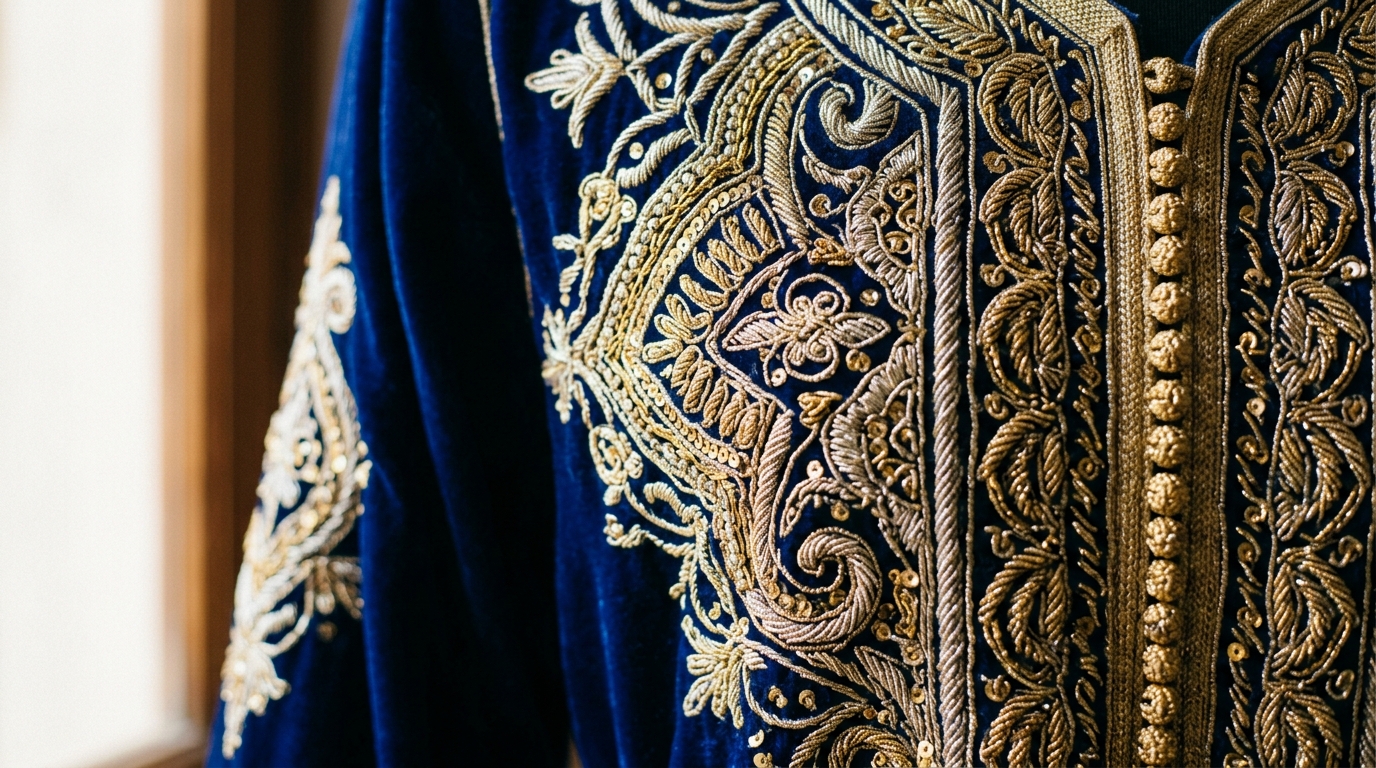
The keswa el-kbira of Tunis with its heavy gold embroidery. The silk and silver of Djerba. The Sfax bridal ensemble with its own distinct weight of jewellery. The woollen and striped weaves of the interior, which are older and plainer and increasingly sought after for exactly that reason.
Most families rent, and hire the woman who dresses the bride and manages the changes through the evening. The number of outfits is the easiest line in the entire budget to reduce without a single guest registering a loss — which makes it the first place to look when the arithmetic stops working.
The groom's side, which nobody describes
Tunisian weddings are usually described entirely from the bride's side, and that is unfair to what actually happens. The groom has his own gathering with his friends, his own trip to the barber and the hammam, and in traditional families he wears the jebba — the long embroidered tunic — with the chechia, and is escorted from his family home with singing and drums.
His real work, though, is earlier and much less visible: the home, the paperwork, and the negotiation with his own relatives about what the family will and will not spend. A groom who lets his uncles set the budget and only discovers the total when the invoices arrive is the groom who begins married life in debt, and he will spend the first two years explaining to his wife why there is no money for a washing machine.
The conversation that prevents most of the arguments
Nearly all the conflict in the weeks before a Tunisian wedding comes from things nobody said out loud. It is worth sitting down once, with both sets of parents in the room, and settling everything in a single conversation rather than in twenty tense phone calls.
Where the couple will live, and if it is with family, for how long and with what privacy. Who is paying for what, item by item, including the outia and the hall. How many guests — decided before the venue is booked, because a room hired for four hundred will be filled with four hundred and the caterer charges per head. Whether either family has reservations about music or mixing, said now rather than discovered on the night. And a ceiling: a number beyond which nobody adds anything, whatever the neighbours did last summer.
Then write the answers down. Two families remembering the same conversation differently is the most common cause of a wedding that turns bitter before it even happens. Our guide on wedding costs and avoiding debt works through the arithmetic without moralising about it.
Marrying into a Tunisian family from abroad
Expect the family to be a participant rather than an audience. Decisions that elsewhere belong to a couple are taken here with parents present, and that is not disrespect towards you — it is how the event is understood.
Expect the paperwork to take months rather than weeks, and expect several documents to expire, so ordering everything at once often means ordering half of it twice. Ask the consulate and the municipality each for their own current list. And ask early where you will live and how often you will travel, because that is a decision made once and lived with for years.
Eleven trays
Amira's outia stayed at eleven. Her mother had settled the number with the groom's mother over tea two months earlier, and both of them had agreed to say, if anyone asked, that this was what the families had decided together. Nobody asked.
What she remembers now is not the trays. It is the hammam, and being fifteen minutes late to her own henna night because her cousins would not let her leave, and her grandmother drawing the harqous herself with hands that shook slightly and lines that did not.
The marriage itself needs very little: the consent of both, a mahr, witnesses, the guardian's involvement, and an announcement rather than secrecy. The outia, the seven nights, the keswa and the harqous are Tunisian culture — much of it beautiful, worth keeping, and none of it obligatory. Knowing which is which lets a family keep the henna and the hammam, hold the walima within its means, and quietly decline the one item that would have cost two years of saving. To compare, read the Algerian wedding next door, or the Moroccan wedding step by step.
Questions families ask
What is the outia?
The gifts sent from the groom's family to the bride before the wedding — fabrics, perfume, sweets, jewellery, sometimes the dress — carried publicly in decorated trays. It is custom rather than obligation, and agreeing the number of trays in advance is the only reliable way to stop it escalating.
Is black henna safe?
Pastes sold as instant black henna sometimes contain PPD, which can cause serious burns and lasting scarring. Traditional harqous and natural henna do not. Always test on a small patch of skin several days beforehand.
How many nights does a Tunisian wedding last?
Traditionally seven, each with its own purpose. Most families now keep two or three. What is worth preserving is the parts that were never about display — the hammam, the henna, and the visit the morning after.
Is polygamy permitted in Tunisia?
No. The Tunisian personal status code has prohibited it since 1956, and the marriage requires the clear consent of both spouses recorded before an official, whatever custom may be invoked in a family discussion.
What is the keswa el-kbira?
The heavy gold-embroidered ceremonial bridal ensemble of Tunis. Other regions have their own — the silk and silver of Djerba, the Sfax ensemble, the woollen weaves of the interior — and most families rent rather than buy.