Guests linked arm in arm dancing the dabke at a Levantine wedding.
The Levantine Wedding: The Jaha, the Contract Conditions and the Dabke
Seven men sat in the room and the coffee went cold in front of them. Nobody would touch a cup until Rasha's father had given his answer.
Seven men sat in the good room and the coffee went cold in front of them.
Rasha's father had poured it himself, which is the whole point of the ritual, and now everyone was waiting. Nobody would lift a cup until he answered. If he said yes, they would all drink together and the room would relax into congratulations. If he said no, the cups would stay untouched, the men would rise, thank him, and leave with nothing damaged — no argument, no humiliation, nothing anyone would have to apologise for at a funeral in twenty years.
That delegation is the jaha, and it is where a Syrian, Palestinian, Jordanian or Lebanese marriage really begins. Everything that follows — the gold, the contract, the dabke line that will not stop until three in the morning — is built on the fact that the request was made publicly, by people whose word can be held against them.
The men who are sent, and why
A jaha is a group of respected men: the groom's father and uncles, an elder of the family, sometimes a sheikh or a neighbour whose word carries weight in the town. Their standing is the message. Sending them says that this request is serious, that the whole family stands behind it, and that nobody is going to disappear afterwards.
The custom is strongest in Palestine and Jordan and lighter in Damascus or Beirut, where the asking may be a smaller family visit. But the logic is identical everywhere: a marriage begins as an agreement between two households, in the open, rather than as a private arrangement between two people that the families are informed of later.
Foreign spouses often find the jaha intimidating, and it helps to understand it as a courtesy rather than a court. Nobody in that room is being examined so much as introduced. The seriousness on display is not suspicion of the groom; it is respect for the weight of what is being asked.
The gold that belongs to her
Once the answer is yes comes the tulbeh, the formal engagement visit — sweets and sharbat, the ring, and usually the gold the groom's family gives the bride. In the Levant that gold is understood plainly as hers: not decoration for one night, but property she owns and can fall back on if life turns. Many families say so directly, and there is no embarrassment in it.
Then there is generally a sahra, an evening for both families to sit together properly, eat, and let the cousins meet the cousins. It is smaller than the wedding and, in a great many families, considerably more enjoyable, because nobody is performing.
The contract, and the lines you are allowed to add
The katb el-kitab is the contract itself, registered before the ma'zoun or at the sharia court, with the guardian involved and two witnesses present. The mahr is written in two parts: a prompt portion given now, and a deferred portion falling due on death or divorce. Across much of the Levant the prompt part is deliberately modest and the deferred part carries the weight.
And here is the feature of this tradition that deserves far more attention than it gets: conditions can be written into the contract, and Levantine families have used that possibility for generations. That the wife may continue her studies or her work. Where the couple will live. That she will not be moved abroad without her agreement. In some contracts the 'isma — the right to initiate divorce placed in her hands.
Two honest observations about this. The first is that a condition written down is worth a great many promises made warmly at an engagement party, and asking for one is not an insult to anybody; it is how careful families have always done it. The second is that a condition you have no intention of keeping should never be signed at all — a broken written promise is worse than an argument avoided.
If you want to understand what may be included and how it is actually enforced, our guide on nikah contract clauses goes through it properly, and the pillars of the marriage contract covers what makes it valid in the first place.
Who furnishes what
The usual division is simple enough to state and difficult to negotiate: the groom provides the home and the bedroom furniture, and the bride's family brings the jhaz — the rest of the furnishing, the kitchen, the linen and her own belongings.
As everywhere in the region, the amounts have grown faster than wages, and the same quiet arithmetic decides whether a couple marries this year or in three. Say the numbers out loud early, in front of both families. Almost every conflict in the weeks before a Levantine wedding starts with two households assuming different figures and neither of them saying so until a deposit has been paid.
The henna, the drums, and the line that will not stop
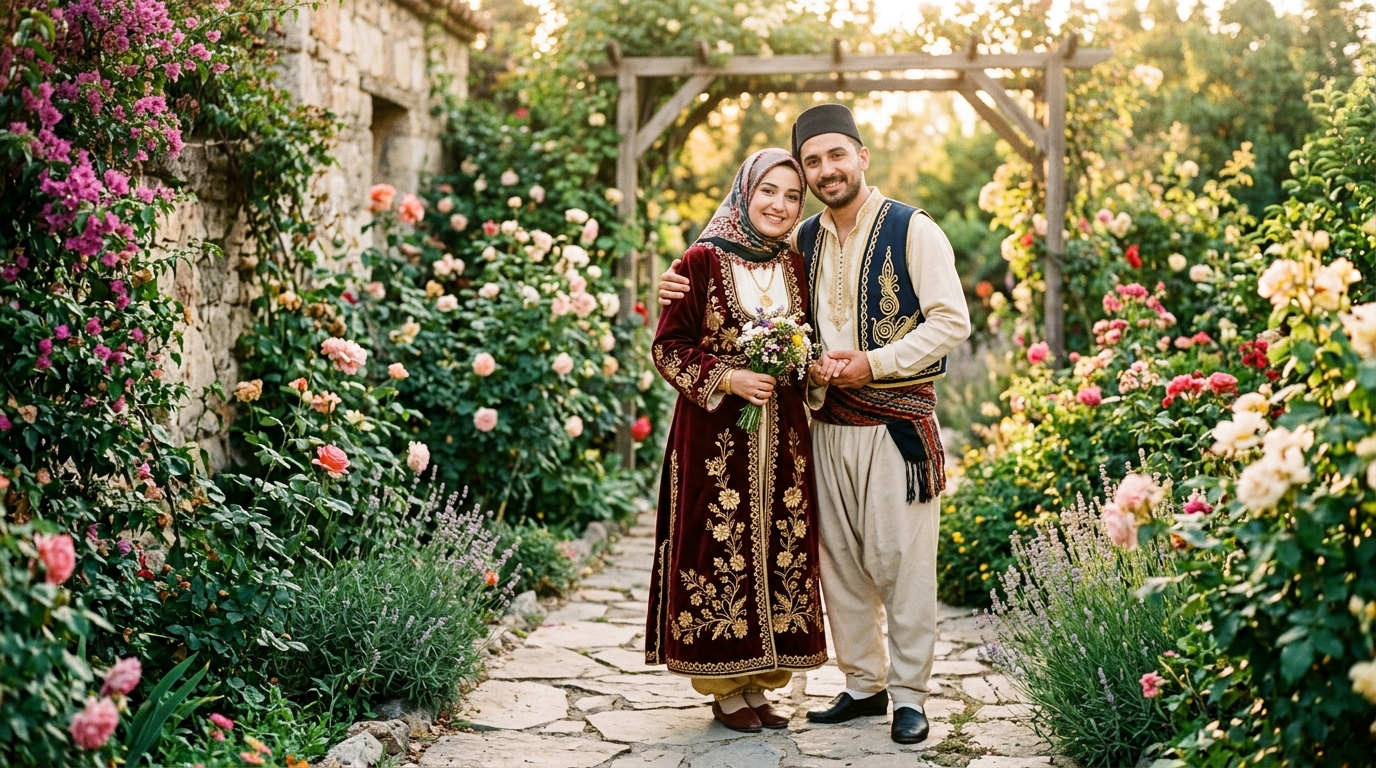
The night before, the women gather for henna: food, singing, the bride in a traditional embroidered dress — the Palestinian thob with its cross-stitch is a language of its own, readable region by region — and the older women leading songs the younger ones half remember. Most brides say this is the part they were actually present for, as opposed to the night they spent being photographed.
The wedding opens with the zaffe, the procession that brings the couple in: drums, mizmar, singers, and in Damascus the arada, with its swords and shields and its call-and-response chanting that fills an entire street.
Then the dabke, which is not a performance here. It is the guests: hands linked, the line growing until half the hall is in it, the person at the head improvising while everyone else holds the step. A Levantine wedding is measured, quietly and without anyone announcing the result, by how long the dabke lasted.
Families who prefer no instruments hold a zaffe with voices and a frame drum alone. It keeps the entrance and the joy and removes the objection, and it is common enough that no hall in the region will be surprised by the request.
The farewell nobody schedules properly
Before the bride leaves her family's house there is the wada'. The women sing to her at the door, sometimes in improvised sung poetry that carries a different name in each country, and the zaghareed go out over the street.
It is the heaviest moment of the day and it is supposed to be. She is not only being married; she is leaving a house. Families who rush this part to keep to the schedule almost always regret it, and the video everyone watches years later is nearly always this one rather than anything filmed in the hall.
When the family is spread across borders
For a great many Syrian and Palestinian families, and for Lebanese and Jordanians with relatives abroad, the wedding no longer happens in one place. Half the family joins on a video call propped against a vase. A grandmother watches from another country and cries at the right moments with a two-second delay. Sometimes the couple themselves are in two countries and the marriage is concluded by proxy through a properly appointed representative.
None of this makes the marriage less real, and it is worth saying so plainly to anyone who feels their wedding was diminished by it. What it does change is the importance of documents. A marriage that must be recognised by more than one state has to be registered correctly from the beginning, with the certificate, the translations and the attestations kept together — because a couple in this situation will be asked to prove their marriage far more often than most: for residency, for a child's papers, for travel, sometimes for a bank.
Two practical things such families do and never regret. They record the call, so the absent relatives are inside the memory of the day rather than outside it. And they hold a second small gathering wherever the other half of the family lives, months later, with no hall and no photographer — which is frequently the warmer of the two events.
The small wedding has become respectable again
The heavy costs are familiar: the hall, the caterer, the zaffe troupe, the photographer, the dress, the gold. In much of the Levant the honest choice is between the wedding and the home, because the same money cannot do both, and pretending otherwise is how couples end up furnishing a flat on credit.
What has changed is that a small wedding is no longer read as a small family. Weddings in a garden or at home, a hundred guests instead of five hundred, sweets and coffee instead of a full dinner, the dabke in a courtyard. And the people suggesting it are often the older relatives who would once have objected, having watched too many young couples begin married life owing money for a night nobody remembers in any detail.
If you are weighing this, wedding costs and avoiding debt is worth reading before the first deposit, and the walima between sunnah and extravagance is a useful corrective when the pressure is coming from relatives rather than from the two of you.
What the coffee was really about
Rasha's father said yes, and everyone drank, and the room filled with the noise it had been holding back for ten minutes. The contract was signed six weeks later, with a line in it about her finishing her degree — a sentence her mother insisted on and her husband did not blink at, which told Rasha more about him than the six months of visits had.
That is the part of this tradition most worth protecting, and it is not the arada or the dabke. It is the habit of writing things down: a contract that records what two people actually agreed, in front of both families, while everyone is still speaking kindly to one another. The music is wonderful and it lasts one night. The written line is what still protects a marriage twenty years later.
The religion itself asks for little: the consent of both, a mahr, witnesses, the guardian's involvement, and a marriage announced rather than hidden. The jaha, the untouched coffee, the shabka, the arada and the size of the jhaz are Levantine custom — a great deal of it generous, and worth keeping. To see how the same contract is dressed elsewhere, read the Egyptian katb el-kitab or the Gulf wedding.
Questions families ask
What is the jaha, and can a family refuse one?
It is a delegation of respected men who formally ask for the bride on the groom's behalf. A refusal is expected to be possible and is handled without insult: the coffee is left undrunk, the men leave, and no argument takes place.
Can a bride really put conditions in the marriage contract?
Yes, and it is long-standing practice in the Levant. Common conditions cover continuing education or work, where the couple will live, not being moved abroad without agreement, and in some contracts the 'isma — the right to initiate divorce placed in her hands.
What is the difference between the prompt and deferred mahr?
The prompt portion is given at the time of the contract; the deferred portion falls due on death or divorce. In much of the Levant the prompt part is modest and the deferred part carries the weight — but it is a real debt, so it should be a figure that could genuinely be paid.
Is a marriage concluded by proxy valid?
Concluding a marriage through a properly appointed representative is an established practice, and families separated by borders use it. Register it correctly and keep the certificate, translations and attestations together, since such couples are asked to prove their marriage more often than most.
Can we have a zaffe without instruments?
Yes. A zaffe with voices and a frame drum alone is common, keeps the entrance and the atmosphere, and removes the objection for families who avoid instruments. No hall in the region will find the request unusual.